
Why cold plates, CDUs, pumps, connectors, fluids and thermal materials are becoming strategic AI infrastructure
The Cooling Supply Chain Behind the AI Data-Center Boom
Executive Summary
AI infrastructure is entering a thermal transition. NVIDIA reference designs already place roughly 225 kW of compute in a standard Rubin rack, while Vera Rubin rack-scale systems use 45°C warm-water direct liquid cooling. [1][2] As rack density rises, cooling shifts from a building-level HVAC function toward an integrated technology supply chain: thermal-interface materials (TIMs), cold plates, quick disconnects, manifolds, coolants, pumps, coolant distribution units (CDUs), heat exchangers and controls. The bottleneck is not simply removing heat; it is doing so with low thermal resistance, low pressure drop, low leak risk, high serviceability and acceptable parasitic power.
Corporate behavior confirms the shift. Modine reported Data Centers segment sales of $348.6 million in its latest quarter, up 90% year over year, and has a customer agreement reserving more than $4 billion of cooling capacity through 2029. [8][9] Vertiv has qualified a 2.3 MW CDU for NVIDIA DSX-ready AI factory infrastructure; Schneider Electric/Motivair now offers CDUs up to 3.5 MW; and nVent has added more than 400,000 square feet of liquid-cooling manufacturing space across three expansions. [5][7][13] The investment opportunity therefore extends well beyond the largest cooling-system vendors to component suppliers whose products determine flow efficiency, reliability, heat-transfer performance and fleet-level uptime.
| Thermal density is now architectural NVIDIA Rubin reference designs are already around 225 kW per rack, and rack-scale systems are designed around direct liquid cooling. [1][3] |
Cooling equipment is moving to MW scale Commercial CDUs now span roughly 2.3–3.5 MW per unit, with coordinated systems designed for 10 MW+ deployments. [5][6][7] |
|---|---|
| Small components can have system-level impact CPC says its full-flow AI connector can reduce pressure drop by up to 90% versus same-size valved connectors, lowering pumping burden. [4] |
Customers are reserving thermal capacity Modine secured a >$4B multi-year capacity agreement and a $165M upfront payment to support expansion. [9] |
1. Cooling Is Becoming Part of the Compute Architecture
A rack full of accelerators creates value only while it can run continuously at useful clock speeds. As accelerator power rises, thermal headroom becomes a compute constraint: if heat cannot move from silicon to coolant quickly enough, the system throttles, reliability margins shrink and expensive GPUs sit below their potential utilization. NVIDIA’s DGX Rubin NVL8 reference architecture places eight systems in a standard rack at approximately 225 kW. [1] Vera Rubin NVL72 uses direct liquid cooling through rack manifolds and cold plates attached to CPUs, GPUs and other high-heat components. [3] NVIDIA also designed the platform around 45°C inlet water, which in many climates allows more heat rejection through ambient conditions and reduces dependence on compressor-based chilling. [2]
That makes cooling a distinct infrastructure thesis. Power infrastructure determines whether a rack can be energized; thermal infrastructure determines whether it can sustain that electrical load without throttling or excessive facility overhead. The supply chain therefore starts at the chip surface and extends through TIMs, cold plates, quick disconnects, manifolds, CDUs, pumps, heat exchangers, facility loops and finally chillers, dry coolers or heat-reuse systems.
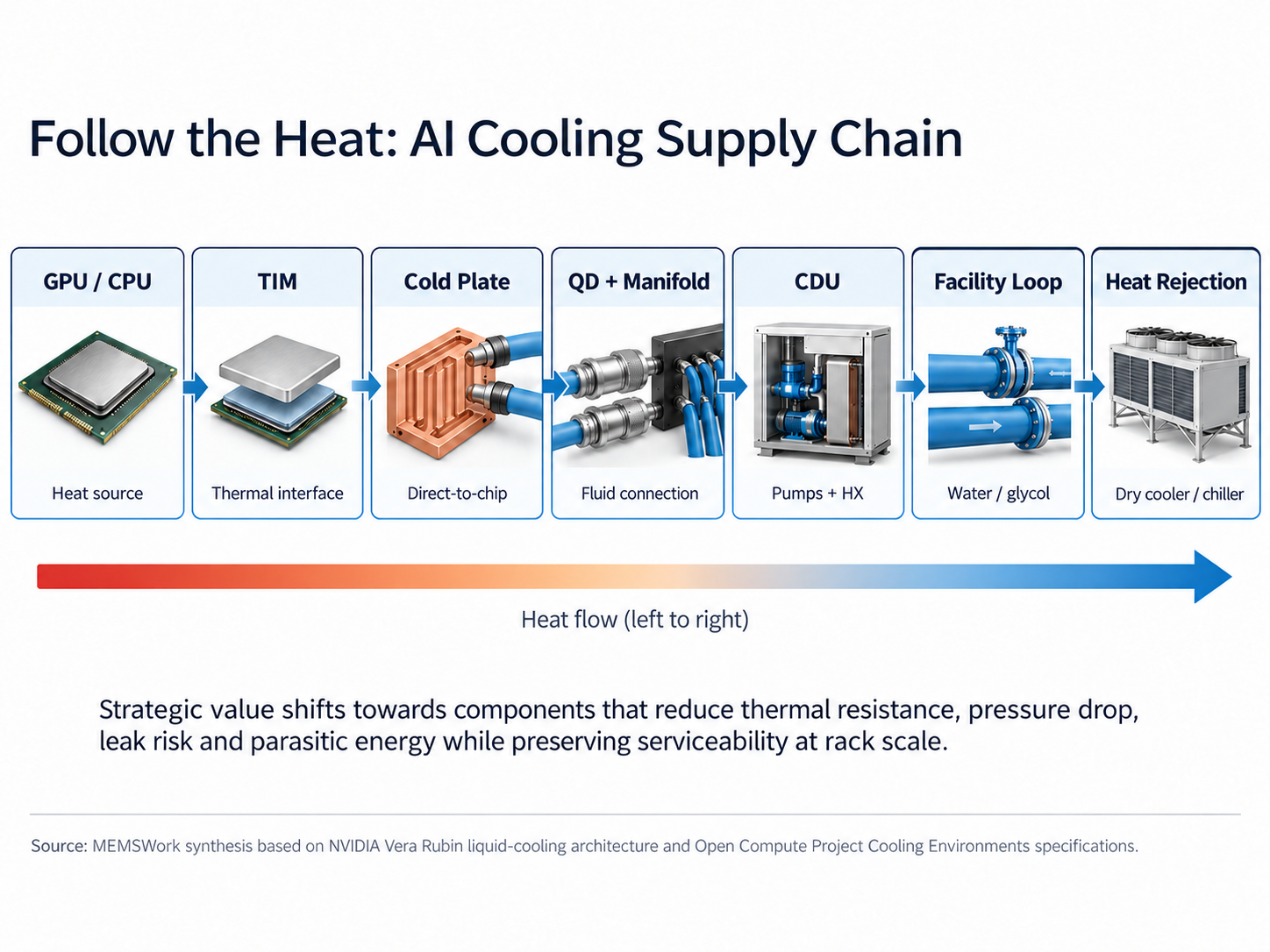
Figure 1. Follow the Heat: The AI Cooling Supply Chain. MEMSWork synthesis based on NVIDIA Vera Rubin liquid-cooling architecture and Open Compute Project Cooling Environments specifications. [2][3][15]
2. The Bottleneck Is in Thermal Resistance, Flow and Reliability
Cold plates are becoming strategically important because they sit at the most thermally demanding interface: directly above high-power silicon. Their job is to provide very low thermal resistance while maintaining uniform flow, manageable pressure drop, corrosion resistance and manufacturability. The Open Compute Project has responded by formalizing cold-plate, coolant, quick-disconnect and CDU workstreams; in 2026 it accepted new specifications for direct-to-chip cold-plate testing and Universal Quick Disconnect (UQD) interfaces. [15][16] Standardization matters because it broadens the supplier ecosystem and reduces integration risk.
Quick disconnects illustrate why apparently minor components can become system-level constraints. Every restriction in a liquid loop raises pressure drop and pumping energy. CPC, a Dover company, says its 2026 Everis DC full-flow connector produces up to 90% less pressure drop than same-size valved connectors. [4] That figure is a vendor claim and will vary with operating conditions, but the mechanism is important: lower restriction can reduce pump energy or free hydraulic headroom for denser cold plates and longer fluid paths. At hyperscale, a connector that saves a small amount of pumping energy can be repeated thousands of times.
3. CDUs Are Becoming Megawatt-Class Industrial Equipment
The CDU is the thermal equivalent of a power-distribution node. It separates the technology cooling loop from the facility loop and manages flow, temperature, pressure, filtration, pumps and heat exchange. Capacity is rising quickly. Vertiv’s NVIDIA DSX-ready CoolChip CDU is rated at 2.3 MW. [5] Schneider Electric’s Motivair MCDU-70 reaches 2.5 MW per unit and is designed to coordinate into systems of 10 MW and beyond. [6] Its newer WCDU reaches 3.5 MW per unit, supports coordinated groups of up to 20 units for 30–40 MW data halls, and can operate at approach-temperature differences as low as 2°C. [7] These are no longer accessory boxes; they are megawatt-scale process systems whose pump reliability, heat-exchanger effectiveness and controls directly influence data-center uptime and operating cost.
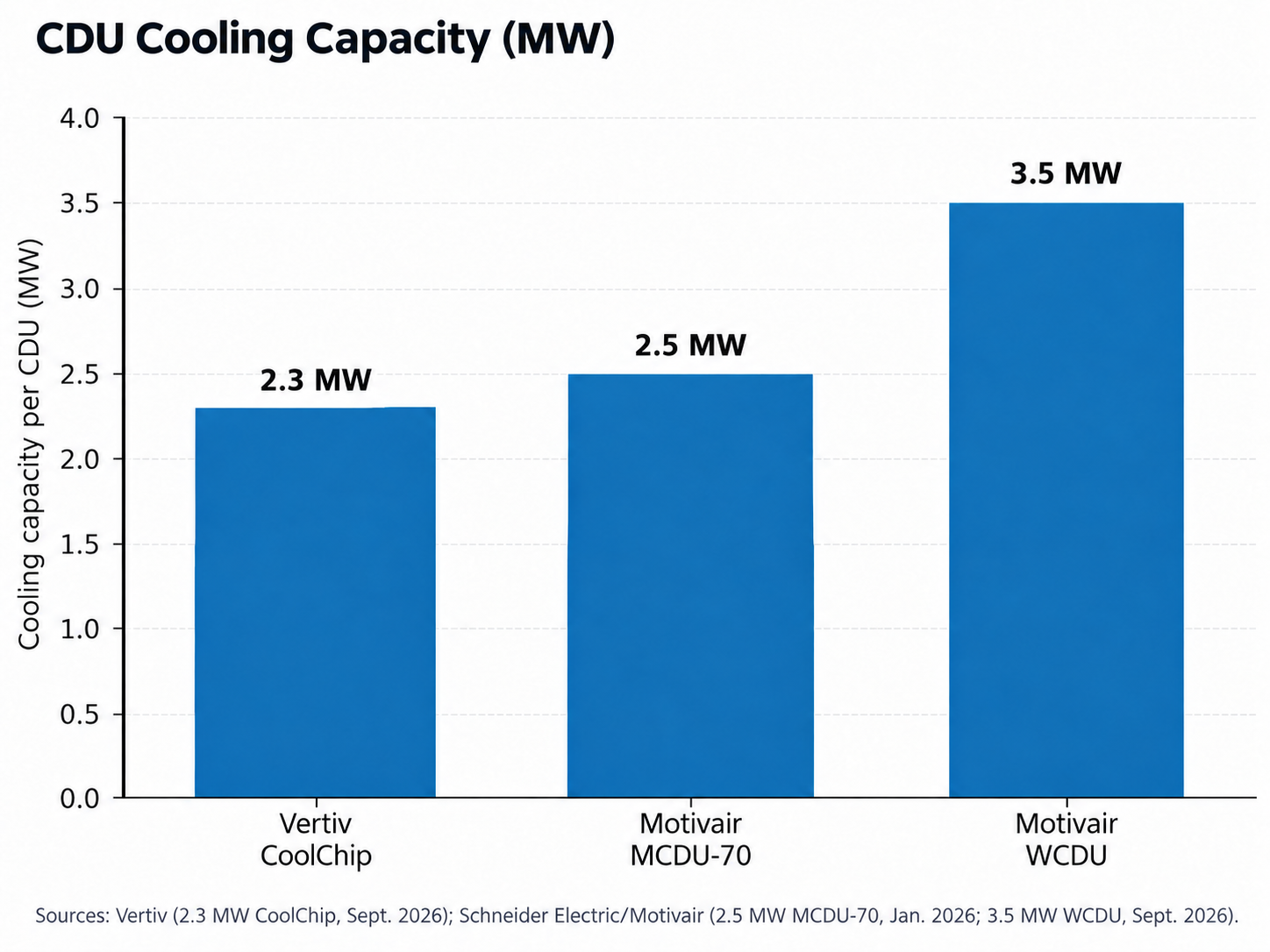
Figure 2. Liquid Cooling Has Moved Into the Megawatt Class. Sources: Vertiv; Schneider Electric/Motivair. [5][6][7]
4. Corporate Capacity Expansion Confirms the Demand Signal
Modine provides one of the clearest financial signals. In fiscal Q1 2027, its Data Centers segment generated $348.6 million of sales, up 90% year over year. [8] In May, a strategic hyperscale customer agreed to reserve more than $4 billion of Airedale cooling capacity for 2027–2029 and provided a $165 million upfront payment to support capacity investment. [9] Vertiv reported Q2 2026 net sales of $3.274 billion, up 24% year over year, while continuing to expand thermal manufacturing and testing capacity. [11][12] Schneider Electric reported Q2 revenue of €11.5 billion, up 17% organically, with demand led by data centers. [17]
nVent is another useful signal from the component and rack-integration layer. Its July expansion added a 160,000-square-foot liquid-cooling facility and brought the company’s cumulative liquid-cooling manufacturing additions to more than 400,000 square feet over three years. [13] In October, nVent and AMD announced a collaboration integrating rack-level cooling into AMD’s Helios rack-scale AI platform. [14] That matters strategically: cooling is moving from an after-the-fact facility choice into the reference architecture of the compute platform itself.
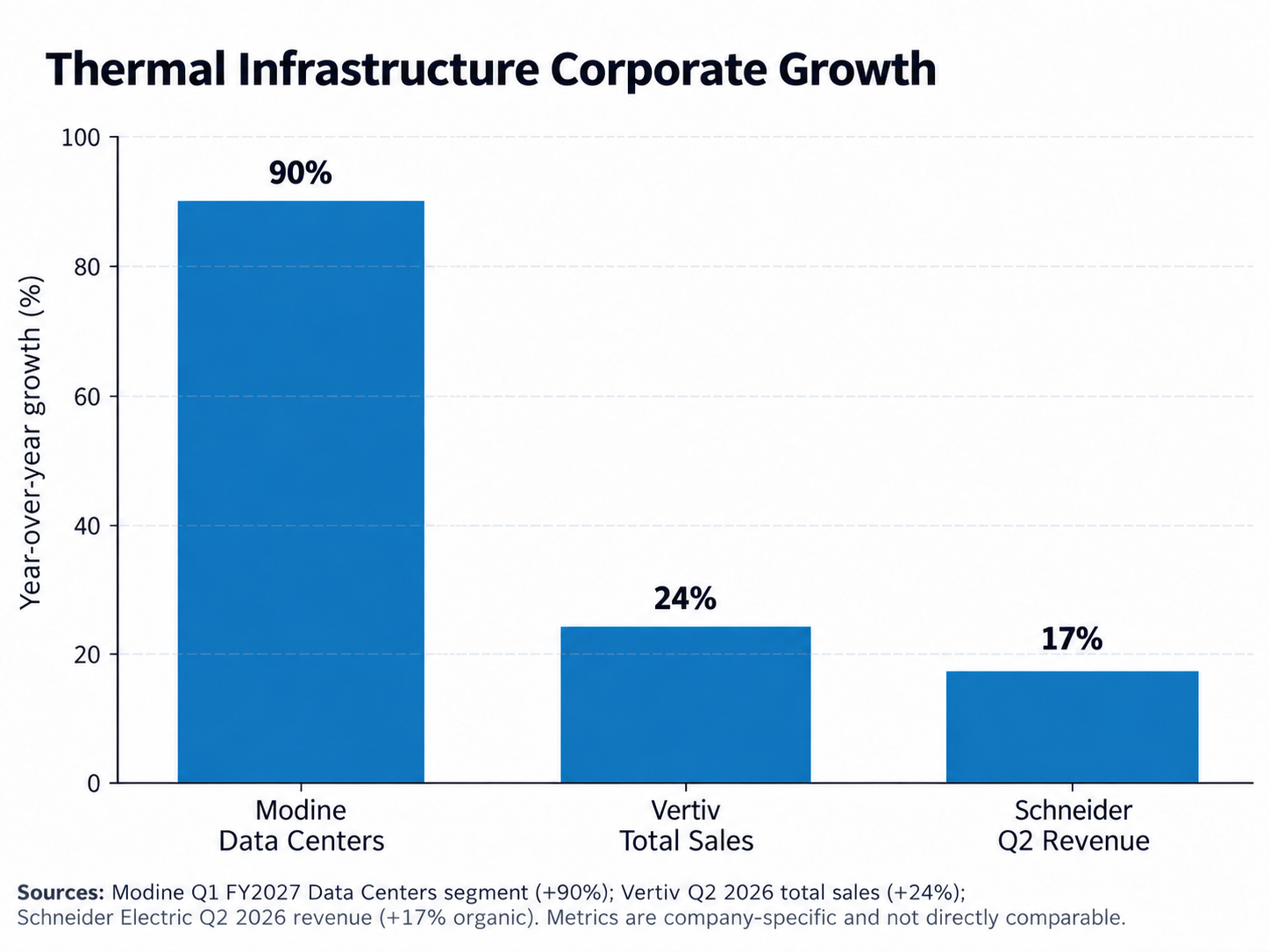
Figure 3. Thermal Infrastructure Demand Is Showing Up in Corporate Growth. Company-specific metrics are not directly comparable. Sources: Modine, Vertiv and Schneider Electric. [8][11][17]
5. How the Cooling Constraint Gets Solved
The first lever is warmer-water direct liquid cooling. Higher coolant temperatures widen the number of hours in which ambient dry cooling can reject heat without mechanical chilling; NVIDIA’s 45°C design point is a prominent example. [2] The second lever is standardization. OCP specifications for cold plates, UQDs, water-based and PG25 coolants, and CDU test methods reduce bespoke engineering and create interchangeable interfaces. [15][16] The third lever is hydraulic efficiency: lower-pressure-drop connectors, optimized manifolds, variable-speed pumps and higher-effectiveness heat exchangers reduce parasitic power. The fourth is hybrid deployment. Schneider’s WCDU is explicitly designed to coexist with fan-wall air cooling, allowing operators to retrofit liquid cooling into existing halls rather than rebuild everything at once. [7]
Fluids and thermal materials are another innovation frontier. Most current single-phase systems use treated water or glycol mixtures, but improved corrosion inhibitors, lower-viscosity formulations, dielectric fluids and nanofluids may change system efficiency. A September 2026 Schneider laboratory test reported 30–50% lower approach temperatures using a graphene nanofluid versus PG25 and estimated a potential 10–15% PUE improvement under similar test conditions; Schneider explicitly states that field validation is still required. [18] This is promising research, not yet a bankable fleet-wide assumption.
6. Innovation and Investment Opportunity Map
| Layer | Constraint | Innovation opportunity | Representative exposure |
|---|---|---|---|
| Cold plates / TIMs | Heat flux, uniformity, thermal resistance | Microchannels, jet impingement, advanced TIMs, additive manufacturing | nVent, Boyd, CoolIT and specialty materials suppliers |
| Quick disconnects / manifolds | Pressure drop, leak risk, serviceability | Full-flow and blind-mate connectors; standardized UQDs | Dover/CPC, CEJN, Parker-Hannifin |
| Pumps / CDUs | Flow control, redundancy, parasitic energy | Variable-speed pumps, hot-swappable architectures, predictive controls | Vertiv, Schneider/Motivair, pump and controls suppliers |
| Heat exchangers / rejection | Approach temperature, facility efficiency | High-effectiveness plate HX, dry coolers, hybrid chiller systems | Modine/Airedale, Vertiv, Schneider |
| Fluids / materials | Viscosity, corrosion, compatibility, lifetime | Advanced glycol chemistry, dielectric fluids, nanofluids, filtration | Chemical/materials suppliers; OCP-qualified ecosystem |
| Sensors / software | Leak detection, fleet optimization, maintenance | Flow/pressure sensors, coolant-quality monitoring, thermal digital twins | Infrastructure software, sensing and controls vendors |
Table 1. AI Cooling Innovation and Investment Opportunity Map. MEMSWork synthesis of component constraints, innovation opportunities and representative industry exposure. Sources: NVIDIA; CPC/Dover; Vertiv; Schneider Electric/Motivair; Modine/Airedale; nVent/AMD; and Open Compute Project. [3] [4] [5] [6] [7] [8] [9] [10] [12] [13] [14] [15] [16] [18]
7. What Could Weaken the Thesis?
The cooling opportunity is strong but not risk-free. A slowdown in hyperscaler capital spending would reduce urgency. Improvements in air cooling or lower-power accelerators could delay liquid adoption in some workloads. Standardization may expand volumes while compressing margins for undifferentiated components. Customer concentration can also be significant, as the Modine capacity agreement illustrates. Finally, rapid capacity additions can create temporary inefficiencies: Modine’s latest quarter included margin pressure from expansion costs and supply-chain constraints even as Data Centers sales rose 90%. [8] Investors therefore need to distinguish durable qualification barriers and proprietary thermal performance from capacity that can become commoditized.
Investor Takeaway
AI cooling is becoming a supply chain rather than a facility afterthought. As rack density rises, the value pool moves closer to the silicon: TIMs, cold plates, connectors, manifolds, fluids and CDUs become part of the compute system, while pumps, heat exchangers and heat-rejection equipment scale into megawatt-class infrastructure. The most interesting opportunities are likely to be components that combine high qualification barriers with measurable reductions in thermal resistance, pressure drop, leak risk or parasitic energy. Power determines how much compute can be energized; cooling increasingly determines how densely and continuously that compute can operate.
References
[1] NVIDIA, DGX SuperPOD Rubin NVL8 Reference Architecture – rack-level power approximately 225 kW. https://docs.nvidia.com/dgx-superpod/reference-architecture/scalable-infrastructure-rubinx86/latest/dgx-superpod-architecture.html
[2] NVIDIA, Vera Rubin POD: 45°C warm-water liquid cooling; coolant examples; free-cooling discussion. https://developer.nvidia.com/blog/nvidia-vera-rubin-pod-seven-chips-five-rack-scale-systems-one-ai-supercomputer
[3] NVIDIA, DGX Vera Rubin NVL72 Hardware Guide – rack manifolds and cold plates on CPUs/GPUs/components. https://docs.nvidia.com/dgx/dgxvr-user-guide/hardware.html
[4] CPC (Dover), Everis DC full-flow connector – up to 90% lower pressure drop versus same-size valved connectors, Aug. 5, 2026. https://www.cpcworldwide.com/About-CPC/News-Room/Press-Releases/CPC-Launches-Everis-DC-Full-Flow-Connectors-for-High-Performance-AI-Cooling
[5] Vertiv, 2.3 MW CoolChip CDU qualified as NVIDIA DSX Ready, Sept. 21, 2026. https://www.vertiv.com/en-us/about/news-and-events/corporate-news/2026/vertiv-coolant-distribution-unit-qualified-as-nvidia-dsx-ready-for-ai-factory-infrastructure/
[6] Schneider Electric/Motivair, MCDU-70: 2.5 MW per unit; coordinated systems scalable to 10 MW+, Jan. 21, 2026. https://www.se.com/ww/en/about-us/newsroom/news/press-releases/motivair-by-schneider-electric-announces-new-cdu-with-capability-to-scale-to-10mw-and-beyond-for-next-gen-ai-factories-6970111e5238242c6201a203/
[7] Schneider Electric/Motivair, WCDU: up to 3.5 MW, 20-unit group mode, 2°C approach temperature, Sept. 23, 2026. https://www.se.com/uk/en/about-us/newsroom/news/press-releases/schneider-electric-launches-new-motivair-coolant-distribution-unit-integrating-liquid-and-air-cooling-for-more-flexible-data-center-deployments-6ab3747ca69498aa7e0695af/
[8] Modine, Q1 FY2027: Data Centers sales $348.6M, +90% year over year, July 29, 2026. https://investors.modine.com/news/news-details/2026/Modine-Reports-First-Quarter-Fiscal-2027-Results/default.aspx
[9] Modine, >$4B Airedale capacity agreement for 2027-2029 and $165M upfront payment, May 26, 2026. https://investors.modine.com/news/news-details/2026/Modine-Announces-Landmark-4-Billion-Long-Term-Capacity-Agreement-through-2029-with-Strategic-Data-Center-Customer-for-Airedale-by-Modine-Cooling-Solutions/default.aspx
[10] Modine, Q4 FY2026: Data Centers sales +158% year over year. https://investors.modine.com/news/news-details/2026/Modine-Reports-Fourth-Quarter-Fiscal-2026-Results/default.aspx
[11] Vertiv, Q2 2026: net sales $3.274B, +24% year over year, July 29, 2026. https://investors.vertiv.com/news/news-details/2026/Vertiv-Reports-Strong-Second-Quarter-2026-with-Diluted-EPS-Growth-of-53-Adjusted-Diluted-EPS-Growth-of-60-Raises-Full-Year-2026-Guidance-Across-All-Key-Metrics/default.aspx
[12] Vertiv, July 2026 thermal manufacturing expansion – planned doubling of regional chiller production by year-end 2026. https://www.vertiv.com/en-latam/about/news-and-events/news-releases/2026/vertiv-expands-global-manufacturing-capacity-for-ai-ready-data-center-cooling-solutions/
[13] nVent, July 31, 2026: 160,000 sq. ft. new site; >400,000 sq. ft. cumulative liquid-cooling manufacturing expansion. https://investors.nvent.com/press-releases/press-release-details/2026/nVent-Expands-Data-Center-Liquid-Cooling-Capacity/default.aspx
[14] nVent and AMD, integrated cooling collaboration for AMD Helios Rackscale, Oct. 13, 2026. https://investors.nvent.com/press-releases/press-release-details/2026/nVent-and-AMD-Collaborate-on-Cooling-for-AMD-Helios-Rackscale-Solution/default.aspx
[15] Open Compute Project, Cooling Environments / Cold Plate sub-project – standardization from cold plate to CDU. https://www.opencompute.org/projects/cooling-environments/cold-plate/
[16] Open Compute Project, 2026 contributions including UQD v2.0, coolant base specifications and cold-plate test specification. https://www.opencompute.org/contributions/?project=Cooling+Environments
[17] Schneider Electric, Q2 2026 revenues €11.5B, +17% organic; demand led by Data Center. https://www.se.com/ww/en/about-us/investor-relations/financial-results/
[18] Schneider Electric laboratory test of graphene nanofluid: 30-50% lower approach temperatures and potential 10-15% PUE improvement; field validation still required, Sept. 3, 2026. https://blog.se.com/datacenter/2026/09/03/new-nanofluid-delivers-measurable-improvements-data-center-cooling-tests/
Research note: Forecasts and vendor engineering claims are identified as such. Corporate metrics are drawn from primary company disclosures. This report is strategic research, not investment advice.