


How Flexible Electronics and AI, are Shaping the Next Wave of Strategic Partnerships in Emerging Technologies (I/II)
The convergence of flexible electronics and AI is fundamentally reshaping innovation through strategic partnerships that combine complementary expertise and resources. These collaborations are accelerating technological advancements, enabling the creation of intelligent, adaptable, and multifunctional solutions across diverse industries, and redefining how businesses tackle emerging challenges and seize opportunities in a rapidly evolving landscape

Introduction
In this two-part series we will look into the need for strategic partnerships and key industry use cases. While, the second part will address their challenges and the existing successful models. Flexible electronics and artificial intelligence (AI) are at the forefront of emerging technologies, catalyzing a profound transformation across industries and redefining the parameters of innovation. These two fields, each powerful in its own right, are converging to create solutions that are intelligent, adaptable, and multifunctional, with applications ranging from healthcare and consumer electronics to automotive design and renewable energy. In a move to address the wider field of flexible electronics, we have shifted focus from wearable to flexible electronics which is a subset of the latter. We will look into the dynamic interplay between flexible electronics and AI, emphasizing how their integration is driving the next wave of strategic partnerships in emerging technologies. It highlights the critical role of collaboration in overcoming the complexities of these rapidly advancing fields, providing insights into how organizations are leveraging complementary expertise, shared resources, and cross-industry innovations to bring transformative ideas to life. By examining key use cases and trends, we hope to reveal how this synergy is not only enhancing the capabilities of modern devices and systems but also shaping a future where the physical and digital worlds are seamlessly interconnected.
Strategic Partnerships in Emerging Technologies
In today’s rapidly evolving technological landscape, strategic partnerships have become indispensable for companies seeking to maintain a competitive edge. These collaborations are particularly crucial in the field of flexible electronics and AI, where the complexity and pace of innovation often exceed the capabilities of individual organizations5. By forging alliances, companies can pool their resources, expertise, and market access to tackle complex challenges and capitalize on emerging opportunities.
Why Partnerships Are Crucial
Accelerating Innovation Cycles
Strategic partnerships play a pivotal role in accelerating innovation cycles within the flexible electronics and AI sectors. By combining the strengths of multiple organizations, these collaborations can significantly reduce the time required to bring new technologies from concept to market1. For instance, when a flexible electronics manufacturer partners with an AI software company, they can jointly develop intelligent, adaptable devices that would be difficult for either party to create independently. This collaborative approach enables rapid prototyping, iterative design, and faster product launches, keeping pace with the ever-shortening technology lifecycles.
Sharing R&D Costs and Reducing Time-to-Market
The development of cutting-edge flexible electronics and AI technologies often requires substantial investments in research and development. Strategic partnerships allow companies to share these costs, making it feasible to pursue ambitious projects that might otherwise be prohibitively expensive for a single entity5. Moreover, by leveraging each partner’s existing infrastructure and expertise, these collaborations can significantly reduce the time-to-market for new products. This is particularly important in the fast-paced world of emerging technologies, where being first to market can provide a crucial competitive advantage.
Accessing Complementary Expertise and Resources
One of the most compelling reasons for forming strategic partnerships in the flexible electronics and AI domains is the ability to access complementary expertise and resources. Flexible electronics companies bring specialized knowledge in materials science and manufacturing processes, while AI firms contribute advanced algorithms and data processing capabilities3. By combining these distinct skill sets, partnerships can create innovative solutions that neither party could achieve alone. For example, a collaboration between a flexible sensor manufacturer and an AI company could result in smart fabrics that adapt to environmental conditions, offering applications in healthcare, sports, and beyond.
Current Trends in Partnerships
Collaboration Between Hardware and Software Companies
A prominent trend in the flexible electronics and AI landscape is the increasing collaboration between hardware and software companies. These partnerships recognize the interdependence of advanced hardware capabilities and sophisticated software algorithms in creating next-generation products3. Hardware firms specializing in flexible electronics bring expertise in creating malleable, durable components that can be integrated into various form factors. Software companies, particularly those focused on AI, contribute the intelligence that makes these flexible devices truly smart and adaptive.
These collaborations are yielding remarkable innovations. For instance, partnerships between flexible display manufacturers and AI companies are resulting in bendable smartphones with intelligent user interfaces that adapt to different usage scenarios. Similarly, collaborations in the medical field are producing flexible, AI-powered wearable devices that can continuously monitor patient health and provide real-time insights to healthcare providers7.
Cross-Industry Partnerships to Create Multi-Functional Products
Another significant trend is the formation of cross-industry partnerships aimed at creating multi-functional products that leverage both flexible electronics and AI. These collaborations often extend beyond traditional tech companies, involving players from diverse sectors such as healthcare, automotive, and fashion2. By bringing together expertise from multiple industries, these partnerships are creating products that blur the lines between different technological domains.
For example, a partnership between a flexible electronics manufacturer, an AI company, and an automotive firm could result in smart car interiors with touch-sensitive surfaces that learn and adapt to driver preferences. In the healthcare sector, collaborations between medical device companies, flexible electronics specialists, and AI firms are leading to the development of intelligent, conformable patches that can monitor various health parameters and provide personalized treatment recommendations4.
The Future of Strategic Partnerships in Flexible Electronics and AI
As flexible electronics and AI continue to advance, the importance of strategic partnerships is only set to grow. These collaborations will likely become more diverse and complex, involving a wider range of stakeholders from different industries and geographical regions. The future may see the emergence of large-scale consortia that bring together multiple companies, research institutions, and even governments to tackle grand challenges in areas like sustainable electronics or human-machine interfaces6.
Moreover, as the integration of flexible electronics and AI deepens, we can expect to see more seamless collaborations where the boundaries between hardware and software become increasingly blurred. This could lead to the development of truly intelligent materials and systems that can autonomously adapt to their environment and user needs9.
In all, strategic partnerships are proving to be the cornerstone of innovation in the realms of flexible electronics and AI. By fostering collaboration, sharing resources, and combining diverse expertise, these alliances are not only driving technological advancements but also reshaping entire industries. As we move forward, the success of companies in these emerging fields will increasingly depend on their ability to forge and maintain effective strategic partnerships, creating a new paradigm of collaborative innovation in the technology sector.
Unveiling the Power of Strategic Partnerships
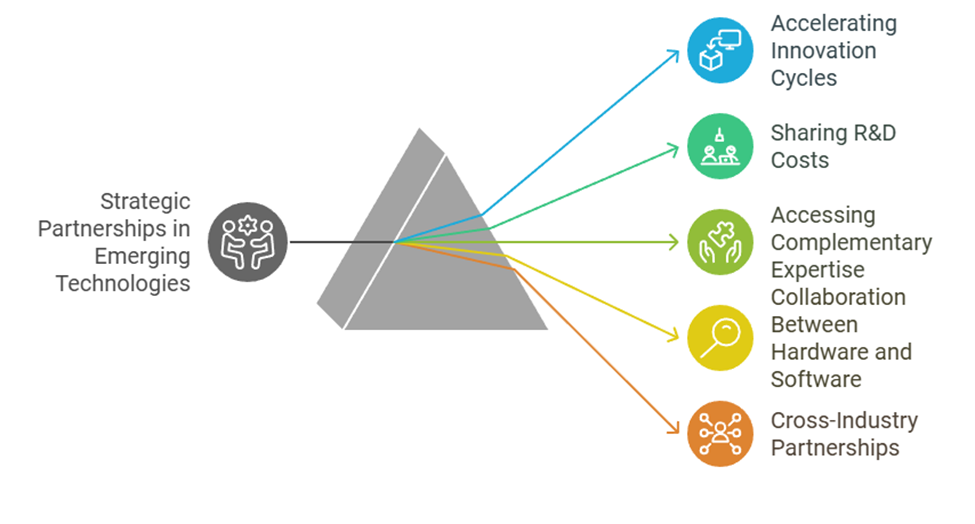
Figure1. Strategic partnerships are essential for driving innovation in flexible electronics and AI, enabling companies to combine resources, expertise, and complementary capabilities to accelerate development, reduce costs, and create groundbreaking, multifunctional technologies that reshape industries.
Key Industries and Use Cases
The convergence of flexible electronics and artificial intelligence (AI) is catalyzing a new era of innovation across multiple industries. This synergy is driving the formation of strategic partnerships that are redefining the technological landscape and opening up unprecedented opportunities for advancement. By examining key industries and use cases, we can gain insight into how these collaborations are shaping the future of emerging technologies.
Healthcare and Wearable Technology
The healthcare sector is witnessing a revolution through the integration of flexible electronics and AI, particularly in the realm of wearable technology. A prime example of this trend is the strategic partnership between Fitbit and Google. This collaboration aims to connect user data from wearable devices to the healthcare system, leveraging Google’s Cloud Healthcare API to link personal data with electronic medical records (EMR)11.
This integration allows healthcare providers to access long-term, up-to-date patient information, enabling more personalized and effective care.
The partnership has led to the development of Device Connect for Fitbit, a service that allows healthcare and life science organizations to utilize data from Fitbit’s health-tracking wearables12. This tool incorporates AI and machine learning capabilities to monitor patients before and after surgery, manage chronic conditions, and collect data for clinical studies. The combination of flexible biosensors and AI algorithms in these wearables enables continuous monitoring of vital signs and activity levels, providing invaluable insights for both patients and healthcare providers.
Furthermore, the collaboration between Fitbit and Google extends to the development of new wearable devices that integrate Fitbit’s health and fitness capabilities with Google’s advanced AI technologies12. This synergy promises to deliver more sophisticated health monitoring solutions, potentially revolutionizing preventive care and chronic disease management.
Consumer Electronics
In the consumer electronics sector, the partnership between flexible electronics manufacturers and AI companies is driving innovation in next-generation devices. Samsung, in collaboration with research institutions like Stanford, is pioneering the development of flexible OLED displays integrated with AI for foldable devices13. These partnerships are pushing the boundaries of what’s possible in smartphone design and functionality.
AI-enhanced foldable smartphones with adaptive screen behaviors represent a significant use case in this domain. These devices leverage flexible display technology to create phones that can transform into tablets, while AI algorithms optimize the user interface and functionality based on the device’s configuration. For instance, AI can adjust app layouts, screen brightness, and power consumption in real-time as the user folds or unfolds the device, enhancing both usability and energy efficiency.
Automotive and Transportation
The automotive industry is embracing the potential of flexible electronics and AI through strategic partnerships aimed at developing advanced human-machine interfaces (HMI) and autonomous vehicle technologies. Collaborations between automotive manufacturers, flexible display producers, and AI firms are resulting in innovative solutions for vehicle interiors and driver assistance systems.
A notable use case in this sector is the integration of flexible electronics in AI-powered autonomous vehicle dashboards. These systems combine curved, flexible displays with AI algorithms to create intuitive and adaptive interfaces. For example, the dashboard can dynamically adjust its layout and information display based on driving conditions, vehicle status, and driver preferences. In autonomous mode, the flexible display can transform to provide entertainment or work-related content, seamlessly transitioning back to driving information when manual control is required.
Energy and Sustainability
The energy sector is witnessing innovative partnerships between energy companies and flexible electronics startups, focusing on AI-driven energy harvesting systems. These collaborations aim to develop more efficient and adaptable renewable energy solutions.
A key use case in this domain is the development of AI-optimized flexible solar panels for smart grids and IoT devices. These panels utilize flexible electronics to conform to various surfaces and structures, while AI algorithms optimize their performance based on environmental conditions and energy demand. The AI component can predict energy generation patterns, manage power distribution, and even adjust the panel’s orientation in some cases to maximize energy capture. This technology has significant implications for urban energy solutions, wearable devices, and off-grid applications.
Robotics and Prosthetics
In the field of robotics and prosthetics, partnerships integrating flexible electronics (e-skin) with AI are driving advancements in human-machine interaction. These collaborations bring together expertise in materials science, sensor technology, and machine learning to create more responsive and intuitive robotic systems.
A prominent use case in this area is the development of soft robotics with AI for more natural human-machine interaction. Flexible electronic sensors embedded in soft robotic structures can detect subtle changes in pressure and movement. When combined with AI algorithms, these systems can interpret complex tactile information, allowing robots to interact more delicately with their environment and with humans. In prosthetics, this technology enables the creation of artificial limbs that can provide sensory feedback to the user, significantly enhancing their functionality and user experience.
The integration of flexible neural electronics, as highlighted by the World Economic Forum, represents a significant breakthrough in this field10. These conformable brain-machine interfaces reduce scarring and improve signal accuracy, vastly outperforming traditional hard probes. This technology has the potential to revolutionize neuroprosthetics, deepen our understanding of brain diseases, and pave the way for true human-AI interfacing.
Overall, the synergy between flexible electronics and AI is fostering a new wave of strategic partnerships across various industries. These collaborations are not only driving technological advancements but are also reshaping business models and creating new market opportunities. As these technologies continue to evolve, we can expect to see even more innovative applications and partnerships emerge, further blurring the lines between the physical and digital worlds.
Synergy of Flexible Electronics and AI
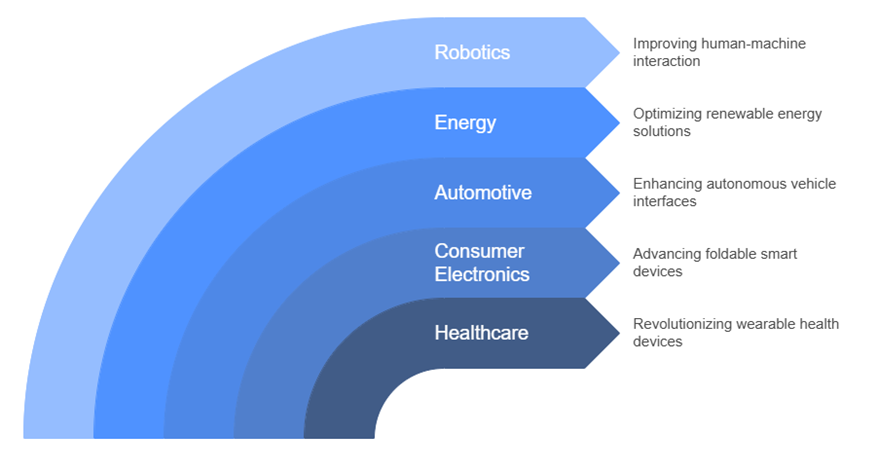
Figure 2. The convergence of flexible electronics and AI is transforming industries by fostering strategic partnerships that drive innovation, create intelligent and adaptive solutions, and open new market opportunities across healthcare, consumer electronics, automotive, energy, and robotics.