Concept illustration of edge-to-server inference; not a depiction of Axelera hardware.


Axelera Europa: Can In-Memory AI Scale from Edge to Server?
Axelera AI’s Europa extends its SRAM-based inference architecture from compact edge systems toward enterprise servers. The chip adds AI cores, local memory and programmable processing, but the commercial question is whether those resources lower the cost of useful inference across real customer models. This article distinguishes available hardware and measurements on the earlier Metis generation from Europa’s internal comparisons and simulations, then examines software portability, OEM qualification and the production evidence needed to test its enterprise case.

On September 15, 2026, Axelera AI said it was shipping Europa, its second-generation AI processing unit, in a chip and two PCIe card formats. It also announced validated Dell and Supermicro systems and collaborations involving European AI factories. The strategic question is larger than whether one accelerator can run a demonstration. Can an architecture developed for power-limited edge inference retain an advantage when models grow, users share a server, and operators need a dependable software stack?
This is a distinct issue from the manufacturing constraints discussed in MEMSWork’s semiconductor onshoring analysis. For specialized AI silicon, success also depends on model coverage, host integration, qualification and utilization after chips leave the fab.
What Europa changes in the hardware
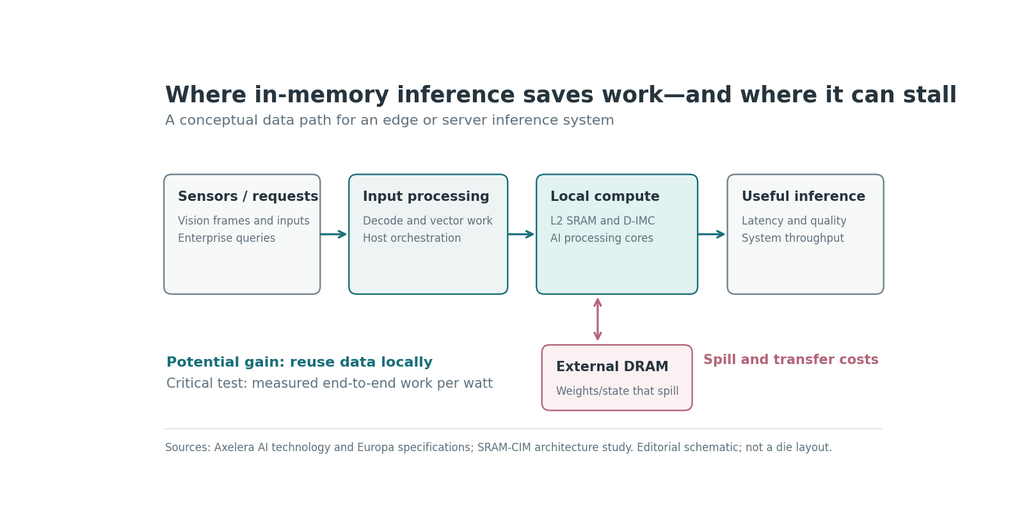
Axelera’s digital in-memory computing approach places arithmetic close to weights stored in SRAM arrays, reducing repeated movement between storage and separate compute units for suitable matrix operations. Digital implementation avoids some precision and noise issues associated with analog in-memory designs. It does not eliminate external memory traffic: large-model weights, activations and attention state can exceed local storage. An independent 2026 architecture study identifies limited on-chip SRAM capacity and off-chip data movement as central constraints for this class of accelerator. The study analyzes SRAM compute-in-memory generally, not Europa specifically.
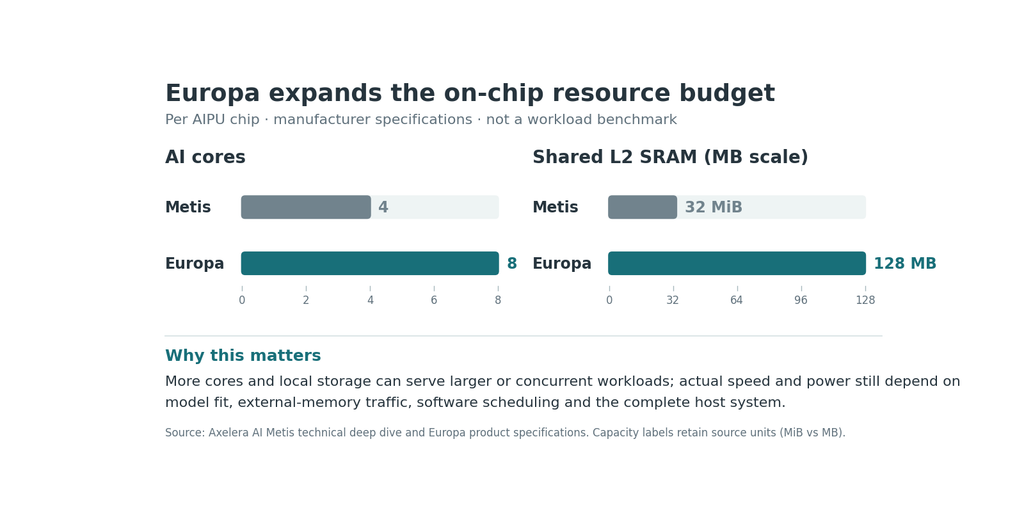
Europa doubles Axelera’s AI-core count relative to its Metis generation to eight. The company’s product specifications list 16 RISC-V vector-processing cores, 128 MB of L2 SRAM, 200 GB/s of DRAM bandwidth, on-board video decoding and integrated preprocessing and postprocessing. Axelera quotes 629 TOPS of peak compute and a 45 W card thermal-design-power figure. These are vendor specifications, not a measurement of wall-plug energy for a full server. The vector cores and video path matter because decoding, resizing, token preparation and other work outside the matrix engine can consume time and host resources.
The product is offered as a half-height Edge 232p card and a full-height Server 250p card, as well as a chip for customer boards. Standard PCIe packaging can lower the integration burden for an OEM, but it cannot by itself establish workload economics. Those depend on memory capacity and bandwidth, batching, software scheduling, host load, cooling and the percentage of time the accelerator stays productive.
Read the performance evidence by maturity level
Axelera has a real installed predecessor. Its Metis benchmark page reports host-side throughput for selected vision networks, with an Intel Core i9-13900K test host. The competitor figures in that table came from public sources rather than one shared controlled test; the table should therefore be read as a vendor comparison, not a universal ranking. A separate Hot Tech Vision & Analysis evaluation described by Axelera tested Metis cards on multi-camera vision workloads. Neither study validates Europa’s language-model economics.
The evidence for Europa is less uniform. The launch release advertises up to six times more tokens per second per watt against GPU alternatives, but labels the chart as Axelera internal results compared with publicly available competitor data. Axelera’s homepage also explicitly labels one Qwen3-30B-A3B throughput figure as a pre-silicon simulation under specified quantization, context and single-user conditions. These are useful engineering signals, yet they cannot substitute for independently reproducible, measured results across relevant workloads and complete systems.
| Evidence level | What is available now | What it establishes |
|---|---|---|
| Product and integration | Europa cards; Axelera says validated Dell and Supermicro systems are shipping | A route to procurement and initial evaluation, subject to customer qualification |
| Prior silicon measurement | Vendor Metis results and a separate multi-camera evaluation | Evidence for the predecessor on selected vision tasks, not Europa server workloads |
| Europa performance claims | Company internal comparisons and at least one explicitly simulated LLM result | A performance hypothesis requiring consistent, measured comparison |
| Production economics | Customer-specific total cost, reliability and utilization data are not publicly established here | The key proof still to be earned at fleet scale |
Table 1. Editorial evidence framework. Sources: Axelera launch, product page, Metis benchmarks and company performance notes. “Shipping” is the company’s statement; this table does not imply audited shipment volume.
A sound buyer comparison would fix model, accuracy target, quantization, input and output lengths, batch size, concurrent users, latency limit and system power boundary. It would include CPU, memory, cooling and idle power as well as the card. MLCommons’ inference methodology illustrates why scenario definitions, quality targets and measured wall power matter; a TDP is not a measured system-power result. TOPS alone does not answer cost per useful inference.
The software boundary may matter more than peak TOPS
Specialized hardware usually performs best when the model maps cleanly onto its operators, memory and dataflow. Novel attention layers, custom operations or changing model families can move part of the work back to the CPU, require a new compiler path, or reduce the advantage of in-memory arithmetic. That makes software portability an economic variable: the cost of adapting models and maintaining them across releases belongs in a customer’s total cost of ownership.
Alongside Europa, Axelera introduced AxeleraScript, a Python-based language for implementing model operators and data movement directly on its cores. Its graph compiler is intended to handle standard models, while hand-written code can cover unusual layers. The company says models produced with the language will start shipping in Voyager SDK 1.9 in September, with language access initially limited to selected customers and public availability planned later. This is a concrete response to model churn, but portability across generations and developer productivity need verification on workloads customers actually own.
For robotics and distributed sensing, it is also worth distinguishing accelerator performance from whole-system autonomy. Cameras, sensors, control loops, networking, safety layers and environmental robustness remain separate constraints. MEMSWork has explored the partnership challenge in MEMS, AI and IoT systems; Europa addresses one compute layer of that broader stack.
Partnerships are a route to validation, not proof of deployment
Axelera says Europa is available in validated Dell XE5 and Supermicro 111AD configurations. Such OEM support can simplify mechanical fit, drivers and enterprise procurement. The company reports more than 600 customers across its portfolio, but has not broken out how many are using Europa, how many are pilots, or how many are recurring production installations. Its stated sales pipeline above $1.5 billion is an opportunity pool, not booked sales. Reuters reported that the chief executive described signed deals worth tens of millions, without disclosing detailed contract terms.
The European AI-factory association requires similar precision. Axelera’s release says Dell, E4 and Axelera are working to support projects in Italy and Luxembourg. Yet EuroHPC’s July procurement description for Luxembourg specifies a Dell system built around NVIDIA GB200 hardware. The two statements can coexist if Europa is evaluated or used in a complementary tier, but the public record cited here does not establish Europa as the contracted supercomputer’s core accelerator. Axelera’s own product page describes IT4LIA as ready to host and validate Europa, which is a more limited milestone than an installed, revenue-generating fleet.
What strategists and investors should watch
The first gate is measured Europa silicon in named systems: end-to-end vision and language-model throughput, latency, accuracy and AC power under published conditions. The second is software coverage: time and engineering effort to port an unfamiliar customer model, then keep it running after a framework or SDK update. The third is production use: purchase orders, repeated deployments, support burden, failure rates and measurable total cost against incumbent options. Watch whether the Edge 232p and Server 250p solve different jobs at attractive utilization, rather than treating a single peak-compute number as proof for both.
There are openings for partners in system validation, model compilation, power-aware workload scheduling and application integration. Their value is strongest where they remove a measured customer bottleneck. For Axelera, the credible upside is a repeatable inference platform from industrial edge equipment to private enterprise servers. The remaining risk is equally concrete: once workloads spill beyond local memory and require more software adaptation, the arithmetic advantage must still survive at the level of a deployed system.
Takeaway
Europa is a meaningful commercial step because the company has moved beyond a chip specification to card formats, OEM validation and a broader software strategy. Its central claim should be judged against measured workload and system economics, with sales pipeline, partner intent, simulation and production deployments kept in separate columns. That evidence, more than the peak TOPS figure, will determine whether edge-first in-memory computing scales into durable enterprise infrastructure.