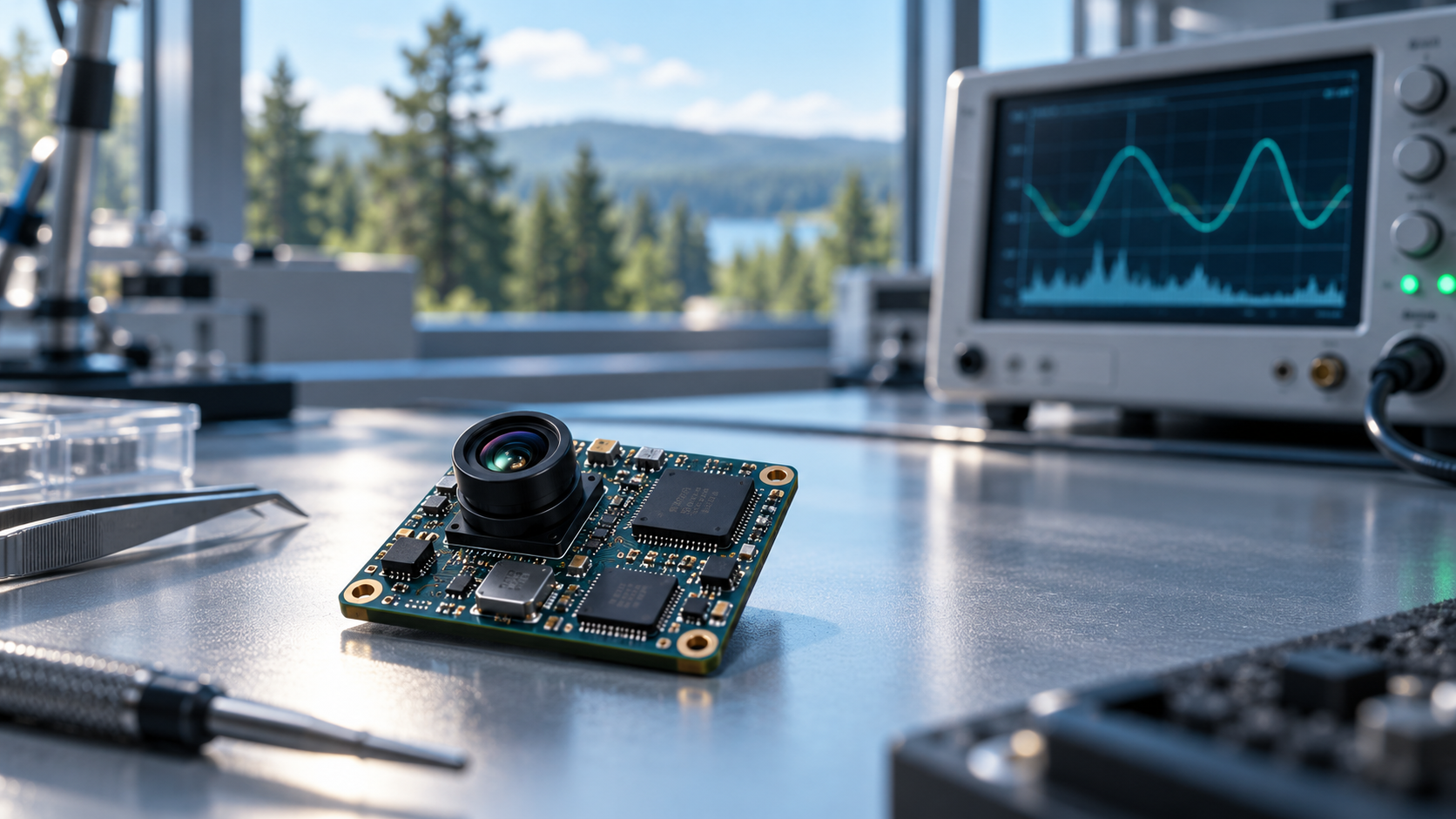
Conceptual camera sensing module and laboratory instrumentation. Original MEMSWork illustration; not a vendor product or a measured waveform.
Edge AI Sensing Needs an Energy per Observation Budget
Edge AI sensing needs a system energy budget that connects useful observations to battery demand. A recent experimental study challenges selection by active power alone. For product teams, the practical response is to qualify the complete acquisition, processing, communication and sleep cycle. Faster computation can help, but only when the surrounding hardware, software and application requirements allow the benefit to survive.
MEMSWork Intelligence Dashboard
| Field | Assessment |
|---|---|
| Market status | Commercial MCU platforms; application-specific energy comparisons remain necessary. |
| Primary constraint | Converting component efficiency into repeatable energy savings at the battery. |
| Demand driver | Autonomous sensing that delivers useful decisions within a maintenance budget. |
| Time horizon | Design choices are actionable now; field lifetime depends on deployment conditions. |
| Technologies to watch | Neural accelerators, power domains, memory retention and workload-aware firmware. |
| Strategic signal | Measurement discipline can differentiate a deployable sensor platform. |
| Next trigger | Reproducible application traces with matched quality targets and measured standby. |
Dashboard: MEMSWork analysis informed by ST’s low-power guidance [2], Ambiq’s Apollo4 Plus documentation [3], ULPMark [5] and MLPerf Tiny [6]. No adoption or lifetime forecast is implied.
What changed in edge AI sensing
A preprint submitted by Lee and colleagues on October 10, 2026 [1] compares an STM32N6-based experimental node with an Apollo4 Plus setup. It reports lower active energy for the faster system across an image acquisition, storage, inference and radio cycle. This is experimental evidence, not a peer-reviewed finding or a universal processor ranking.
The decision question is straightforward: which architecture delivers the required observation and response with the lowest total deployment burden? Answering it requires a workload, a quality threshold and a defined electrical measurement boundary. The processor’s advertised efficiency is an input to that decision, not its conclusion.
This advances a different question from MEMSWork’s light-to-token vision analysis. That article considers a change in sensing architecture. Here the issue is how to select and qualify a complete embedded implementation.
What the experimental comparison establishes
The study’s active totals [1] are 5517.4 mJ for the Apollo4 Plus setup and 1066.2 mJ for the STM32N6 setup. Different cameras and interfaces were used. The former sums major component measurements, excluding regulator losses and residual board leakage; the latter measures the whole board at the battery. These boundaries prevent a chip-only interpretation.
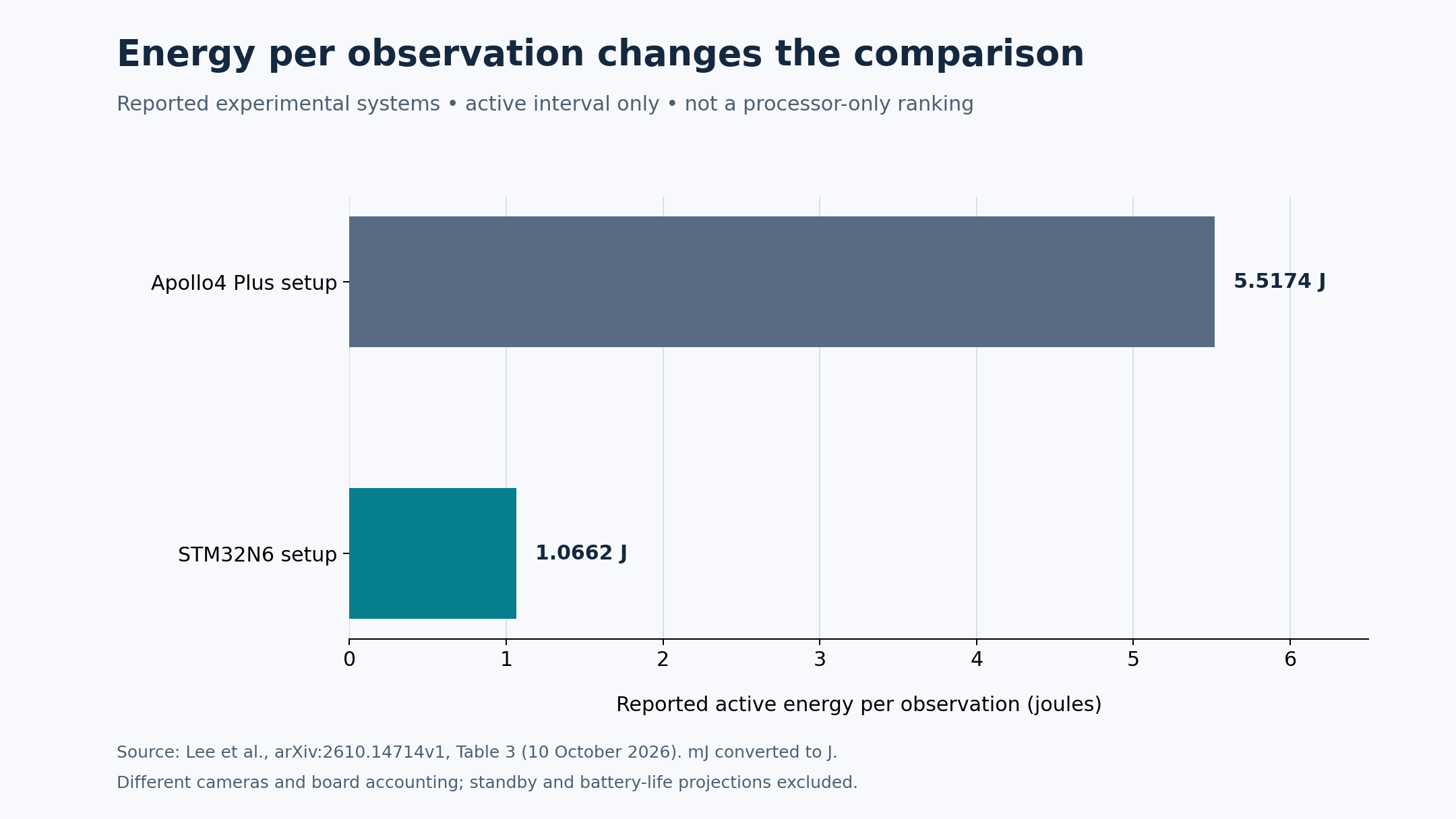
Figure 1. Original MEMSWork plot of Lee et al., Table 3 [1], converting reported millijoules to joules. Totals include overlapping stages; individual stages are not summed here. This is an experimental systems comparison, excluding standby and projected battery life.
The paper’s lifetime calculations use datasheet standby assumptions. They are projections, not field endurance measurements. Figure 1 therefore confines the comparison to reported active energy. Independent replication was not identified in the sources reviewed. [1]
The useful managerial implication is to request an energy trace tied to an accepted task. A favorable result should remain favorable after the design team accounts for the actual camera, storage, power conversion and reporting policy. Otherwise, the comparison has answered a narrower question than the buyer intended.
Power management is a board and firmware decision
ST’s application note on STM32N6 low-power modes [2] describes tradeoffs among consumption, wake-up time and retained peripheral capability. A low-power mode is consequently an operating configuration with consequences for resumption and state, rather than an unconditional attribute of the chip.
Ambiq’s Apollo4 Plus documentation [3] likewise identifies sleep modes with selectable RAM and cache retention. Retention matters because a product may need to preserve state between observations. The appropriate comparison must use the state each application genuinely needs, rather than the deepest mode available on a specification sheet.
ST’s discrete power-supply reference [4] explicitly includes power sequencing and low-power management alongside regulators, external memory, camera and storage. That documentation supports a practical diligence rule: inspect the circuit around the processor. A peripheral left powered, a regulator selected for the wrong load regime or a firmware path that fails to complete can dominate the outcome.
Engineering teams should make every energized domain explain its purpose during inactivity. They should also verify recovery after a wake event, including access to retained data and restart of the sensing pipeline. A design that saves energy by losing required state has changed the product specification.
Benchmarks help when their boundaries are respected
EEMBC’s ULPMark framework [5] separates behavioral profiles for sleep, peripherals and active workloads. Its premise is that a single datasheet number cannot represent application tradeoffs. That makes it useful for structuring a comparison, while leaving product-specific acquisition and communication behavior to be measured separately.
MLPerf Tiny [6] couples inference tasks with quality targets and latency measurement, and supports optional energy measurement. Its closed division constrains model changes for comparison; its open division permits greater flexibility. A result’s division and model therefore matter when interpreting an efficiency claim.
Neither framework should be presented as proof of a finished sensor’s lifetime. The correct hierarchy is component characterization, workload benchmarking, board validation and deployment evidence. Each layer answers a different question. Skipping a layer can turn a legitimate benchmark into an unsupported product promise.
| Decision boundary | Evidence to request | Failure to detect |
|---|---|---|
| Useful observation | Declared input, model and acceptance threshold. | Energy reduced by weakening the task. |
| Active cycle | Battery-side trace covering acquisition through return to sleep. | Costs omitted between isolated benchmarks. |
| Standby and wake | Retained state, powered domains and verified resumption. | Leakage or restart overhead hidden by chip specifications. |
| Deployment | Representative event rates, reporting policy and failure recovery. | Laboratory savings lost in real operation. |
Table 1. Original MEMSWork evaluation framework, informed by ULPMark’s operating profiles [5], MLPerf Tiny’s quality and measurement rules [6], and ST’s power-supply guidance [4]. These are proposed diligence requirements, not reported test results.
Commercial value depends on the observation contract
A sensor supplier and its customer should agree on what constitutes a useful observation before optimizing the hardware. Required image detail, tolerated delay, acceptable missed events and the need to preserve raw evidence all affect that contract. A small transmitted result may satisfy an alarm application while being inadequate for a workflow that needs later forensic review.
Local inference introduces another tradeoff: communication savings must be evaluated alongside model maintenance. A detector that performs well initially may encounter unfamiliar conditions. The product needs a strategy for reviewing errors and updating software without making its normal energy budget meaningless.
For corporate innovation teams, this suggests purchasing an evaluation around an agreed task rather than around a headline efficiency ratio. For investors, repeatable measurement infrastructure, validated firmware and evidence from customer workloads may be more defensible assets than a demonstration assembled from available parts.
Manufacturing variation also deserves attention. The energy budget should tolerate approved component substitutions, storage behavior and power-supply differences. This connects to MEMSWork’s supplier-qualification analysis: the valuable deliverable is a reproducible operating envelope, supported by clear interfaces and acceptance criteria.
What to Watch Over the Next 12 Months
Watch for replication using matched sensing requirements, documented firmware and a consistent battery-side measurement boundary. Disclosure of unsuccessful configurations would help establish where the approach stops being useful.
Look for measured standby in final hardware, including retained memory, sensors and power conversion. Repeat testing after software changes and peripheral substitutions would reveal whether the budget is a maintained engineering asset or a snapshot of an early prototype.
Customer evidence should connect energy to service outcomes: observation quality, reporting reliability, recovery after faults and actual maintenance demand. A field trial should explain its event distribution and environmental conditions before generalizing endurance to another application.
What Would Change the Thesis?
The thesis is that energy per accepted observation, combined with measured inactivity, is a better selection basis than active power alone. It would strengthen if multiple teams reproduced savings under matched tasks and those savings survived final hardware and field operation.
The case for a more capable processor would weaken where measured standby dominates the intended deployment, where acceleration cannot shorten the critical path, or where the application requires frequent raw-data transmission. It would also weaken if the quality or recovery requirements erased the apparent advantage. Those outcomes would favor a different architecture for that workload, without invalidating the measurement approach.
Sources and methodology
The graph reproduces reported totals with unit conversion. The experimental preprint is not peer-reviewed evidence or independent industrial qualification. Vendor documentation establishes capabilities, not independent application performance. The dashboard and proposed evaluation criteria are MEMSWork analysis. No market forecast, maintenance-cost estimate or battery-life prediction is offered.
[1] Lee et al., experimental edge AI sensing study, preprint, October 10, 2026; Table 3
[2] STMicroelectronics, AN5946: How to optimize low-power modes on STM32N6 MCUs
[3] Ambiq, Apollo4 Plus product documentation
[4] STMicroelectronics, AN6000: How to build the discrete power supply for STM32N6 MCUs
[5] EEMBC, ULPMark ultra-low-power benchmark framework
[6] MLCommons, MLPerf Inference: Tiny benchmark
Last updated: October 26, 2026. Initial publication; formatting and numbered references revised for editorial review. Material updates should record replication, final-board measurements and field evidence separately.