Anthropic’s Model Hardware Standard: The Missing Layer for Physical AI?
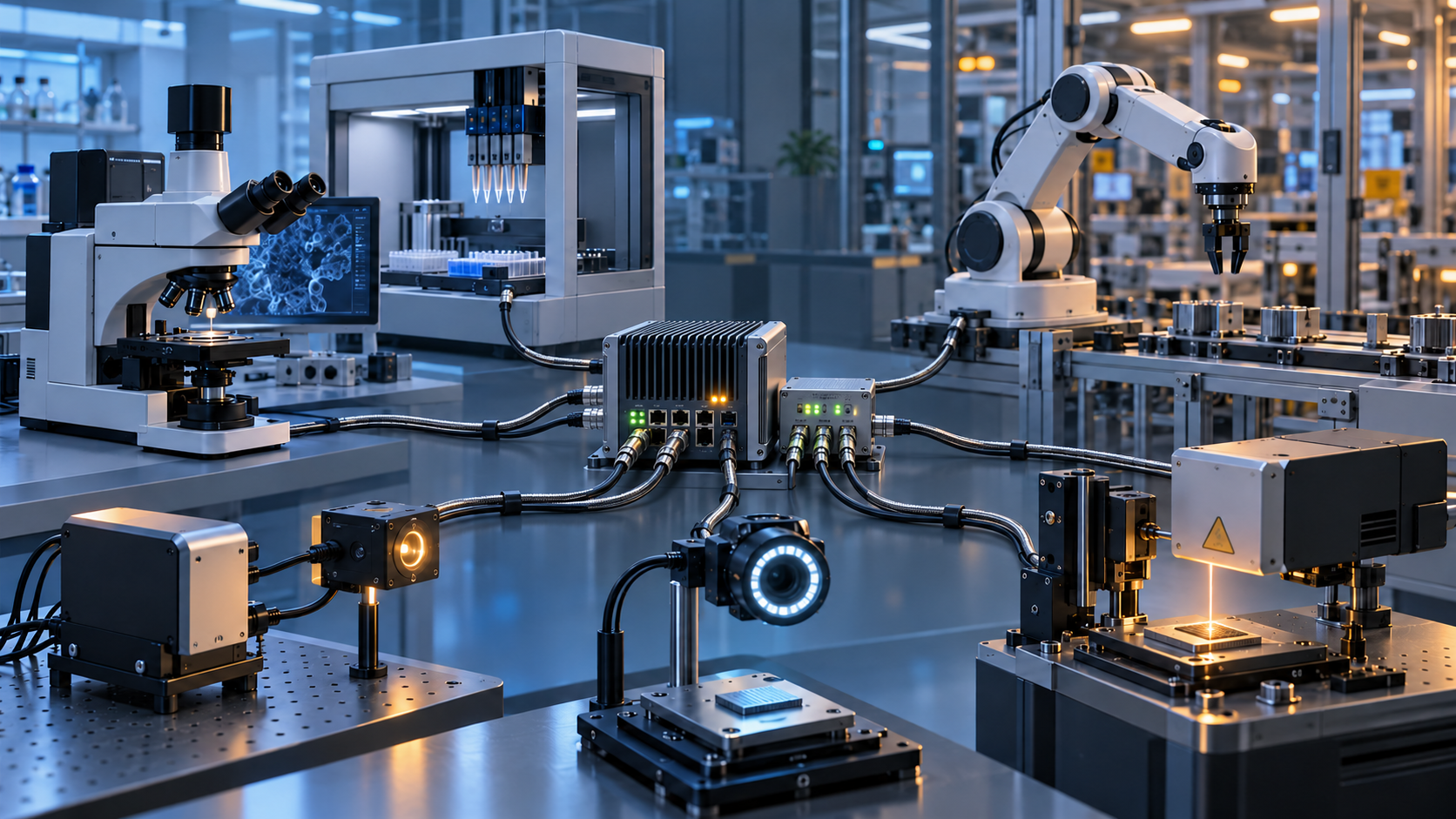
Anthropic’s Model Hardware Standard (MHS) proposes a common way for AI agents to discover, monitor and operate laboratory and manufacturing equipment. Early pilots show unusually fast integration and useful closed-loop experimentation, but they remain proofs of concept. The strategic opportunity is not to replace PLCs, robot controllers or safety systems. It is to add an agent-facing orchestration layer above deterministic control—and to make permissions, auditability and physical constraints part of the interface from the start.
On August 27, 2026, Anthropic opened a research preview of the Model Hardware Standard, developed initially with HHMI Janelia Research Campus. The specification is intended to let AI agents operate heterogeneous instruments through standardized drivers and simple primitives such as read and write. Anthropic says MHS can connect any device with a programmable interface and can expose that device to agents through the Model Context Protocol, a command-line interface or code APIs (Anthropic).
That sounds like an integration announcement. Its larger significance is architectural. Physical AI has no shortage of models, sensors, robots or laboratory equipment; it has a shortage of trustworthy interfaces between reasoning systems and machines. If MHS gains adoption, it could become an agent-facing control plane for flexible laboratories and mixed-vendor equipment. But the first pilots also show why natural-language orchestration cannot be confused with deterministic, safety-rated control.
What MHS changes
Traditional automation is usually engineered around known devices and repeatable workflows. Each instrument exposes its own commands, data formats and error codes, while integrators write custom software to coordinate the full system. The approach works well when a line repeats the same operation at high volume. It becomes expensive when equipment changes frequently, experiments evolve during a run, or a facility combines instruments from several vendors.
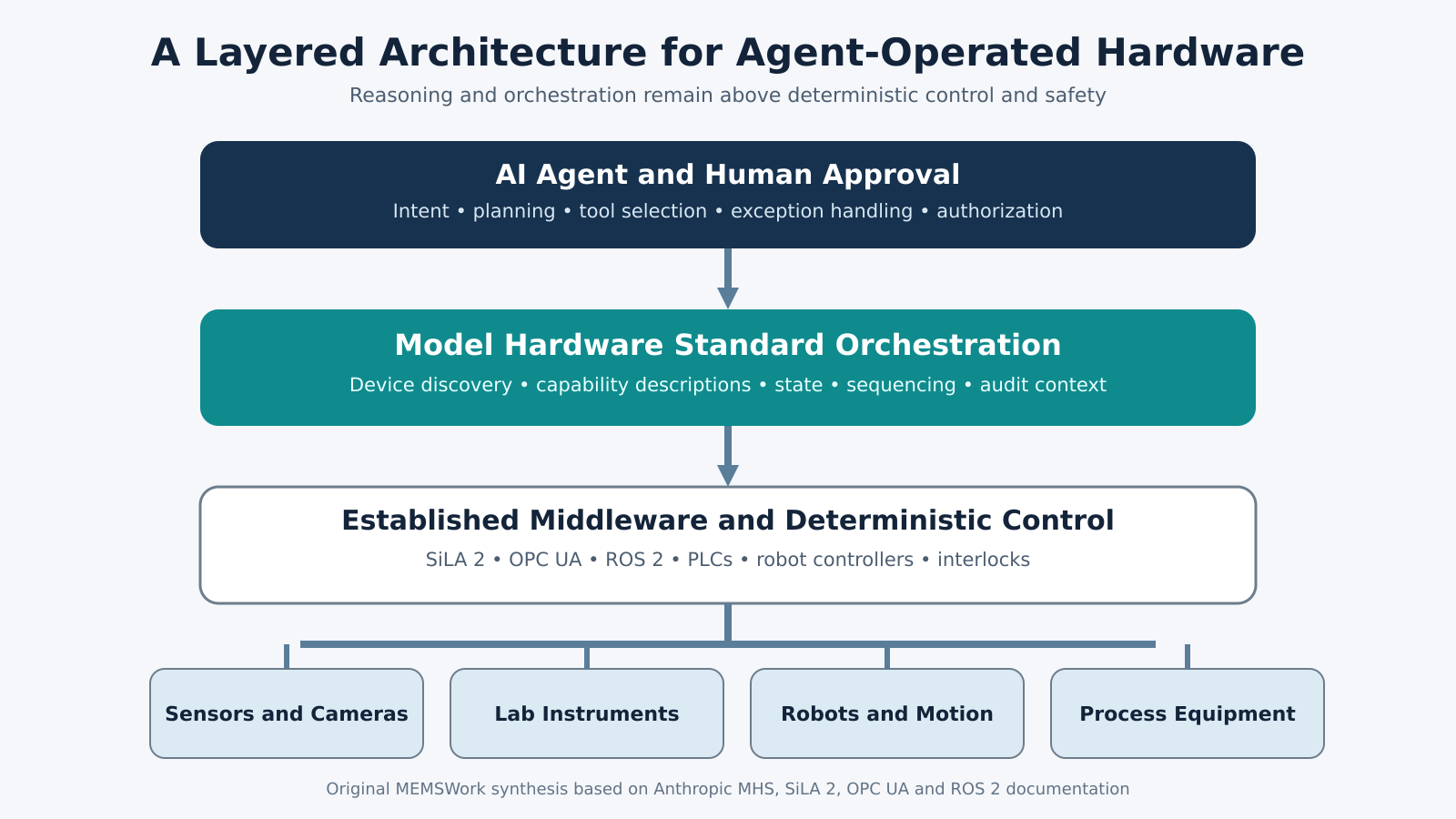
MHS inserts a standard driver layer between an AI agent and those device interfaces. A driver describes what the machine can measure, what can be changed and which safety limits apply. The agent can then discover connected devices, read their state, sequence work across them and generate deterministic code for operations that should not depend on online model reasoning (Anthropic).
This is an important distinction. The agent is most valuable at the orchestration level: interpreting intent, selecting tools, planning a sequence, handling exceptions and updating parameters from observed results. Fast motion control, emergency stops, interlocks and tightly timed loops should remain inside deterministic controllers and device firmware.
The early evidence is promising—but narrow
Anthropic’s preview compiles several partner pilots rather than an independent benchmark. The results are still useful because they expose both the potential and the failure modes.
At Genentech, MHS coordinated a liquid handler, robotic arm and plate reader for a protein assay using standard 96-well plates. Claude optimized different flow rates for water and viscous protein solution, arriving at approximately 140 microliters per second for water and 10 microliters per second for the protein sample. The system also encountered tip-pickup and liquid-detection errors. It recovered from some faults, but needed human guidance when repeated mixing created more bubbles because the model did not understand the physical cause of the failure (Anthropic).
In another partner pilot, researchers deliberately introduced six unsafe or invalid conditions—including a missing plate, a disconnected camera and an active emergency stop. The system blocked all six before motion. The end-to-end integration and autonomous dilution run took eight hours, while the partner described conventional vendor delivery as a process measured in multiple weeks. The comparison is company-reported and not controlled, but it points to where MHS may create value: reducing the engineering cost of one-off and low-volume automation (Anthropic).
At HHMI Janelia, a microscopy rig previously required seven vendor programs to be launched in a fixed order. MHS reduced startup to one dashboard action, and adding a camera reportedly fell from a multi-day integration task to a few minutes (Anthropic).
The QuEra quantum-computing pilot offers the strongest quantitative result. A deterministic relock script learned through agent-led experimentation recovered a laser lock in 695 of 700 trials, or 99.3%. Difficult disturbances took 10–14 seconds versus 5–10 minutes for a human operator. In a separate tuning exercise, Claude ran 363 experiments over 16 unattended hours and reduced reported residual error from 15.7 millivolts to 1.55 millivolts. QuEra also notes that the final relock controller was a deterministic, inspectable script rather than an AI agent left permanently in the fast control loop (QuEra; Anthropic).
Where MHS fits among existing standards
MHS enters a field that already has mature interoperability layers. The strategic question is therefore not whether MHS replaces them, but whether it can sit above them.
| Layer | Primary role | Strategic fit with MHS |
|---|---|---|
| SiLA 2 | Open device and service interoperability for laboratory automation | A natural laboratory-device layer beneath agent orchestration; its feature descriptions can support vendor-independent workflows (SiLA). |
| OPC UA | Secure information modeling, discovery and command-and-control across industrial systems | A mature plant-to-enterprise backbone that can expose governed equipment data and services to an MHS adapter (OPC Foundation). |
| ROS 2 and ros2_control | Robot middleware and real-time-capable hardware control frameworks | Appropriate for robot drivers and motion control below the agent layer; MHS can request tasks without owning the servo loop (ros2_control). |
| MHS | Machine-readable descriptions and agent-facing orchestration across heterogeneous devices | Potential semantic and reasoning layer above device APIs and established control stacks; currently a limited research preview (Anthropic). |
Table 1. MHS is best treated as a complementary agent-orchestration layer, not a replacement for established laboratory, industrial or robot-control standards. Source: original synthesis based on the linked specifications.
OPC UA is especially instructive. Its specification already covers information models, discovery, authentication, encryption, integrity, alarms, audit trails and command-and-control from devices to enterprise systems. MHS may simplify how a reasoning agent understands and uses those capabilities, but it does not eliminate the need for the underlying security, conformance and timing mechanisms (OPC Foundation).
The real bottleneck is trust, not connectivity
Connecting an agent to a microscope is one problem. Allowing it to change temperature, move a robot or dispense a reagent without creating unacceptable risk is another.
The first requirement is bounded authority. Every driver should enforce safe ranges, state-dependent permissions and device-level interlocks outside the language model. Higher-risk actions should require explicit human approval, while routine reversible adjustments can be delegated. Anthropic’s pilots already show that an agent may stop for confirmation when uncertain, which is safer than improvising but can also halt an unattended workflow (Anthropic).
The second requirement is traceability. A production implementation needs immutable logs of the requested objective, device state, selected command, approval path, measured result and recovery action. OPC UA provides security and audit mechanisms that could support this lower layer. At the AI-governance level, the NIST AI Risk Management Framework emphasizes incorporating trustworthiness into the design, use and evaluation of AI systems rather than treating safety as a final test (NIST).
The third requirement is physics-aware validation. The Genentech bubble example illustrates a recurring limit of general-purpose models: an error code does not contain all of the physical context. Systems will need sensor fusion, digital twins, machine-specific constraints and reusable failure-recovery skills. For high-consequence equipment, an agent’s proposal should be tested against a deterministic rule set or simulation before execution.
Commercialization will depend on the driver ecosystem
MHS will create strategic value only if it reduces integration work across many facilities, not just carefully supported demonstrations. That depends on three ecosystem questions.
First, who creates and certifies the drivers? Instrument vendors can provide authoritative interfaces, but independent integrators may move faster across installed legacy equipment. A viable market may emerge for validated driver libraries, protocol gateways and conformance testing.
Second, who owns operational knowledge? Much of laboratory and factory performance lives in undocumented setup procedures, technician judgment and recovery routines. Encoding that knowledge into reusable machine descriptions and skills could become a defensible asset, but it raises questions about intellectual property, cybersecurity and portability.
Third, can MHS remain model-agnostic? Anthropic says the standard can work with any agent harness and plans to release it as open source after the preview. Until the specification, governance process and conformance tools are public, adopters cannot fully assess interoperability or vendor dependence (Anthropic; Reuters).
For companies developing intelligent sensors, laboratory instruments, robotics or edge systems, the opportunity is broader than building another AI model. Valuable positions may form around secure device gateways, machine-readable capability descriptions, policy engines, digital-twin validation, anomaly detection, audit infrastructure and certified recovery workflows. This extends the ecosystem logic discussed in MEMSWork’s analysis of MEMS, AI and IoT partnerships and complements the distinction between accelerator capability and whole-system autonomy in the recent Axelera Europa analysis.
What strategists and investors should watch
- Publication of the specification, reference implementation and governance model.
- Independent replication of the pilot results across more device vendors and facilities.
- Conformance tests for drivers, permissions, audit logs and failure recovery.
- Integration with SiLA 2, OPC UA, ROS 2 and safety-rated control systems.
- Evidence that MHS reduces lifecycle integration cost, not only initial setup time.
- Clear liability and human-approval rules for high-consequence actions.
Takeaway
MHS is an early but strategically important attempt to give AI agents a common interface to the physical world. The pilots suggest that agents can reduce the cost of heterogeneous integration, monitor experiments continuously, search parameter spaces and turn successful behavior into deterministic code. They also show that models still lack physical intuition and need bounded authority.
The durable architecture is therefore likely to be layered: AI for intent, planning and exception handling; MHS for discovery and orchestration; established middleware for secure data exchange; and deterministic controllers for timing and safety. If Anthropic can build an open driver ecosystem with credible conformance and governance, MHS could become a useful bridge between agentic AI and real equipment. If it remains a closed preview or blurs orchestration with control, it will be another promising interface that industrial users cannot yet trust.
Sources
- Anthropic, “Previewing the Model Hardware Standard,” August 27, 2026.
- Reuters, “Anthropic unveils new framework allowing AI agents to operate physical devices,” August 27, 2026.
- QuEra, “Holding the Light: Teaching an AI to Lock and Tune Our Quantum Computer’s Lasers”.
- OPC Foundation, OPC Unified Architecture, Part 1: Overview and Concepts.
- SiLA, Frequently Asked Questions on SiLA 2.
- ros2_control, official documentation.
- NIST, AI Risk Management Framework.
- Anthropic, “Introducing the Model Context Protocol”.