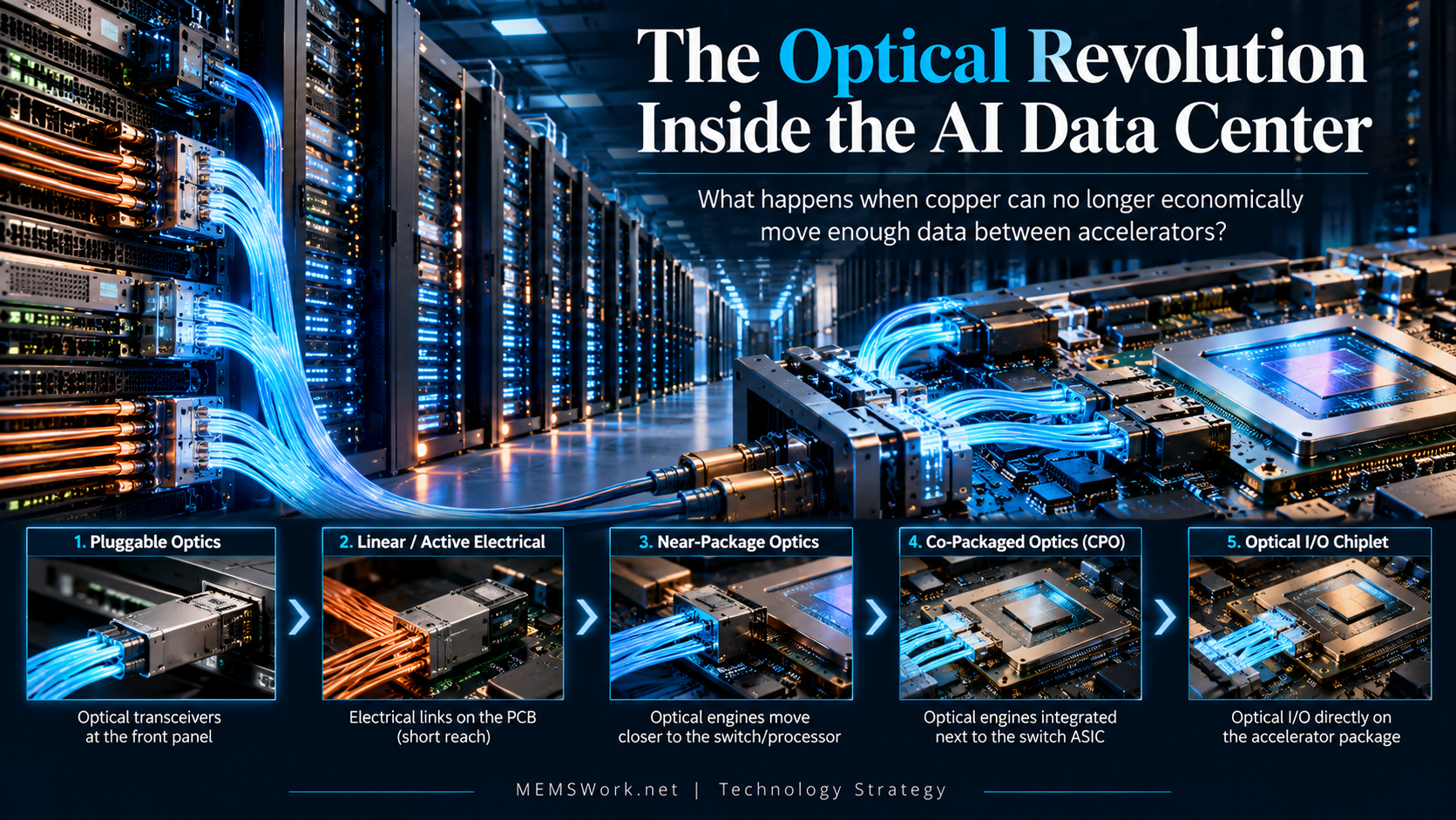
The Optical Revolution Inside the AI Data Center
How the electrical-to-optical boundary is moving toward the processor—and where value may migrate next
AI networking is approaching a physical transition. Copper will remain valuable at short reach, but higher lane rates and denser accelerator fabrics raise the power, signal-conditioning and board-complexity cost of moving bits electrically. The strategic shift is therefore not “copper versus fiber,” but where electrical-to-optical conversion occurs: at the front panel, near the package, beside the switch ASIC, or eventually on the accelerator package itself.
Executive Summary
AI systems are becoming limited not only by how fast processors calculate, but by how efficiently data can escape the package and traverse the fabric. Broadcom is shipping a 102.4-Tb/s co-packaged-optics Ethernet switch, while NVIDIA’s Spectrum-X Photonics SN6800 reaches 409.6 Tb/s at the switch-system level. At the other end of the architecture, Intel has demonstrated a 4-Tb/s bidirectional optical I/O chiplet and Ayar Labs’ UCIe-compatible TeraPHY roadmap reaches 8 Tb/s. These figures measure different scopes and are not directly comparable, but together they show optics migrating inward—from the faceplate toward the processor package. [1] [2] [3] [4]
The financial signal is equally important. Broadcom’s Q3 FY2026 AI semiconductor revenue reached $16.7 billion, up 221% year over year; Credo’s Q1 FY2027 revenue rose 114.7%; Lumentum’s Q4 FY2026 revenue reached $1.01 billion versus $480.7 million a year earlier; and Marvell’s Data Center revenue grew 46% year over year. Marvell also paid $3.5 billion for Celestial AI, while Ayar Labs raised $650 million of primary capital in 2026 to scale manufacturing-ready optical I/O. The investment question is therefore shifting from “who sells optics?” toward “who owns the integration, light sources, DSPs, packaging, connectors and test technologies that make optical I/O economic at scale?” [9] [10] [12] [7] [6] [5]
Key Findings
| Shift | What is changing | Investor / strategy implication |
|---|---|---|
| Electrical reach | Higher lane rates require more equalization, retiming and power as distance rises. | AECs, retimers and improved SerDes remain important while the optical crossover moves inward. |
| Optical boundary | Pluggables are giving way selectively to NPO, CPO and optical-I/O chiplets. | Value shifts toward photonic engines, lasers, fiber attach, package integration and known-good-engine test. |
| System architecture | Optics is entering scale-up fabrics, not only rack-to-rack networking. | Optical I/O becomes part of the accelerator architecture and may expand the addressable market beyond transceivers. |
| Manufacturing risk | Yield, alignment, serviceability and thermal control become gating constraints. | Packaging/test and precision connectivity can capture disproportionate value if qualification barriers remain high. |
1. The Bottleneck Is the Electrical I/O Boundary
The important transition is not that copper suddenly stops working. Copper remains attractive for very short links because it is mature, serviceable and inexpensive. The problem is that electrical signaling becomes progressively more expensive as lane rate, reach and channel loss rise. More equalization, retiming and power are required to maintain signal integrity, while printed-circuit-board routing and connector loss consume part of the energy budget before a bit reaches the network. At extreme bandwidth density, the system can save power by converting to light earlier.
That is why the likely architecture is hybrid rather than binary. Broadcom’s Tomahawk 6 generation simultaneously extends passive copper at short reach and offers a 102.4-Tb/s CPO variant, while OCP’s 2026 photonics program explicitly treats XPO, NPO and CPO as part of the forward design space. The crossover point depends on reach, lane rate, cost, yield and service model—not on a universal rule that fiber is always superior. [1] [13] [15]
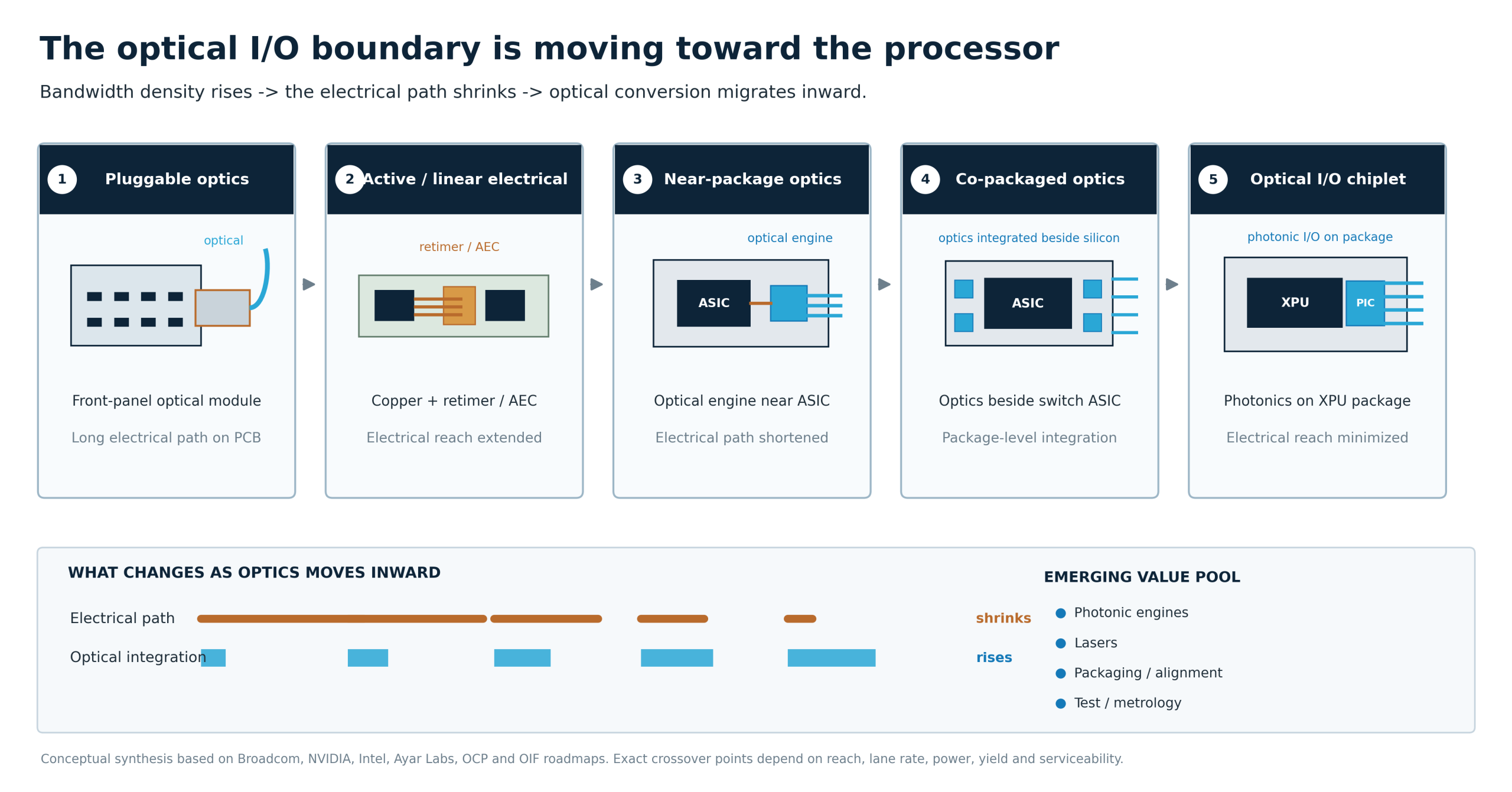
Figure 1. The optical I/O boundary is moving toward the processor. The upper sequence shows the progression from front-panel pluggable optics to optical I/O on the XPU package; the lower panel highlights the shrinking electrical path, rising optical integration, and emerging value pools in photonic engines, lasers, packaging/alignment, and test/metrology. The progression is conceptual; exact crossover points depend on bandwidth, reach, power, yield and serviceability. Sources: Broadcom, NVIDIA, Intel, Ayar Labs and OCP/OIF programs [1] [2] [3] [4] [13] [15].
2. From Pluggables to In-Package Optical I/O
Traditional pluggable optics preserve modularity: an optical module sits at the switch faceplate and can be replaced independently. Near-package optics shortens the high-speed electrical path by moving the optical engine closer to the ASIC. Co-packaged optics goes further by placing photonics beside the switch silicon. The next architectural step is optical I/O on the compute package itself—an especially important distinction from MEMSWork’s earlier CPO production analysis, which focused on manufacturing and serviceability at the switch. [16]
Intel’s integrated optical compute interconnect chiplet demonstrated 4 Tb/s of bidirectional optical I/O and is designed to be co-packaged with CPUs, GPUs and other SoCs. Ayar Labs’ current TeraPHY roadmap reaches 8 Tb/s bidirectional bandwidth using a UCIe electrical interface, while the company says the technology can connect packages across distances from millimeters to kilometers. These are vendor-reported capabilities, but strategically they show the electrical-to-optical conversion boundary moving onto the XPU package itself. [3] [4]
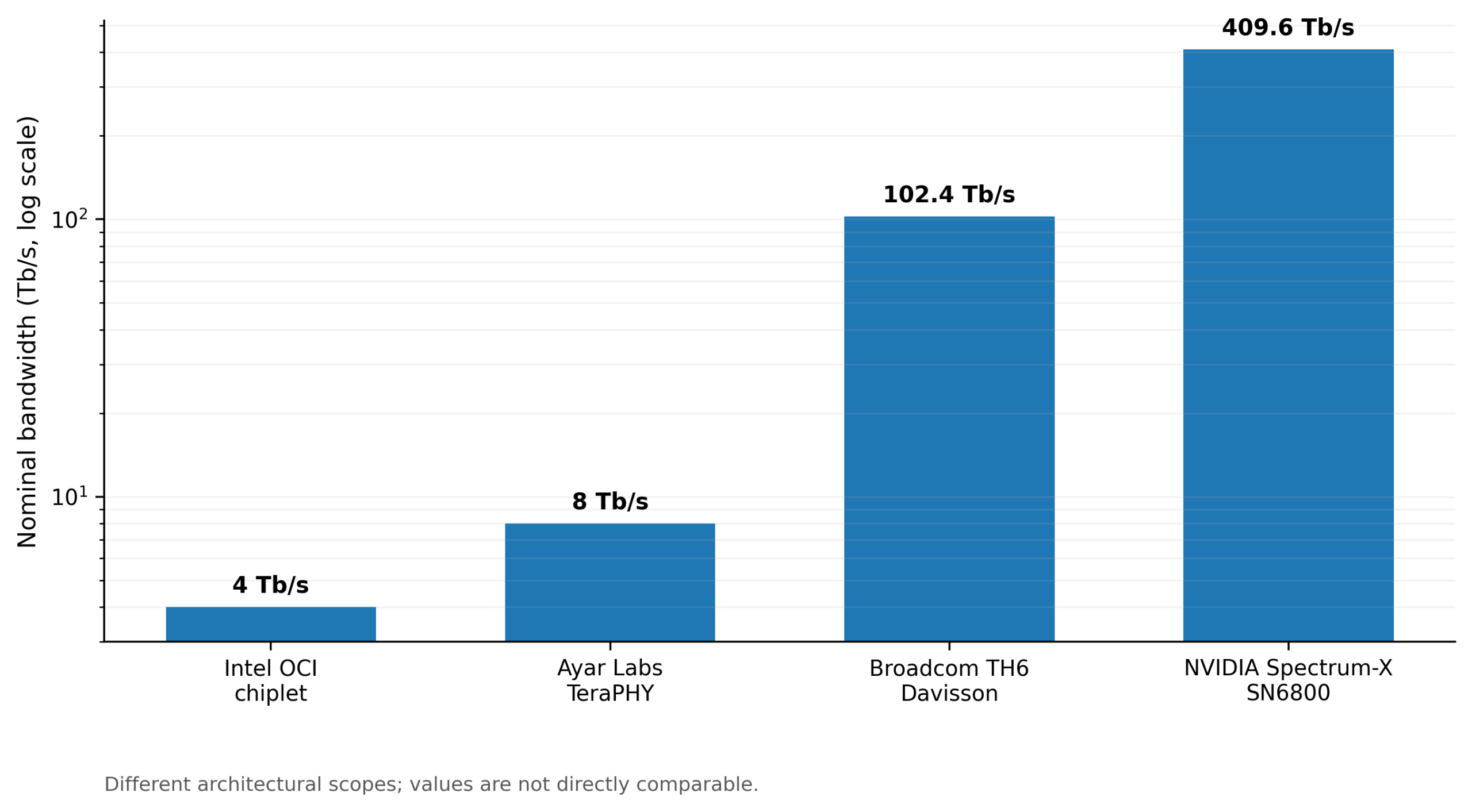
Figure 2. Optical integration is scaling from chiplet-level I/O to 400+ Tb/s switch systems. Metrics refer to different architectural scopes and are not directly comparable. Sources: Intel, Ayar Labs, Broadcom and NVIDIA [1] [2] [3] [4].
3. Corporate Activity Suggests the Value Pool Is Moving
The capital allocation is no longer subtle. Marvell completed the acquisition of Celestial AI in February 2026 for total purchase consideration of $3.5 billion. Celestial’s Photonic Fabric is aimed at scale-up connectivity, and Marvell expects initial revenue in the second half of fiscal 2028, reaching a $500 million annualized run rate in Q4 FY2028 and $1 billion by Q4 FY2029. Separately, Marvell says optical interconnect has compounded at roughly 50% annually for five years and represents about half of its Data Center revenue. [6] [8]
Credo illustrates the hybrid transition. The company’s portfolio spans copper and optics, while its proposed DustPhotonics acquisition adds silicon photonics to optical DSPs and transceivers. Credo expects the combined optical portfolio to exceed $500 million of revenue in fiscal 2027. Lumentum reported Q4 FY2026 revenue of $1.01 billion and highlighted 1.6T modules, optical circuit switching, ultra-high-power CPO lasers and external-laser-source orders as new growth layers. Ayar Labs raised $650 million in primary capital during 2026 to fund high-volume manufacturing readiness for optical I/O. [10] [11] [12] [5]
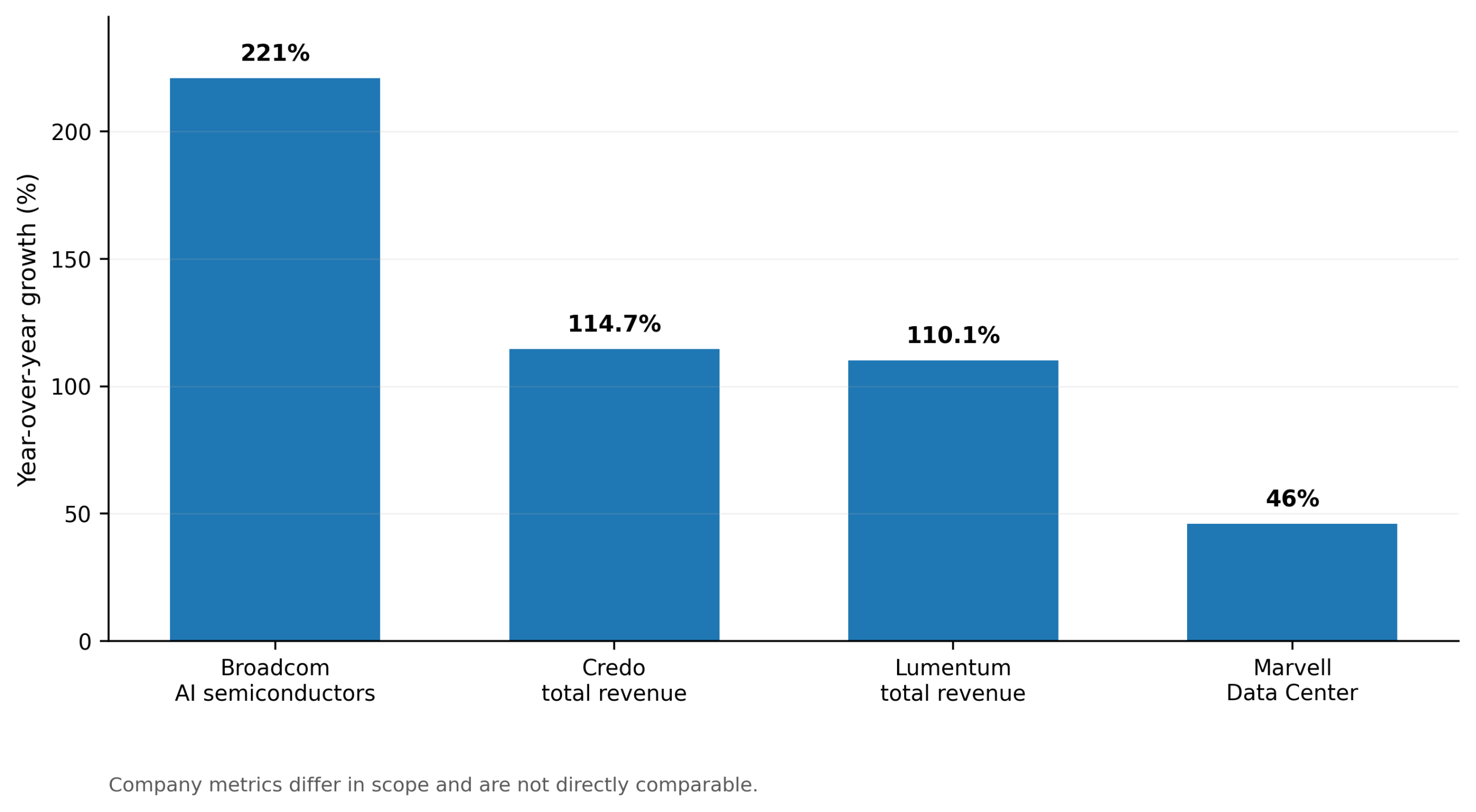
Figure 3. Optical and AI-connectivity demand is already visible in selected company growth metrics. The measures differ in scope and should not be compared as like-for-like optical revenue. Sources: Broadcom, Credo, Lumentum and Marvell [7] [9] [10] [12].
4. Optics Solves One Bottleneck by Creating Another
Optical I/O reduces electrical reach, but it creates a more demanding integration problem. Optical engines must be aligned, attached, cooled, tested and connected to fiber beside high-value switch or accelerator silicon. Light sources must meet reliability and thermal requirements. Fiber density becomes a mechanical design problem. And serviceability becomes harder: replacing a failed pluggable module is straightforward; repairing an integrated optical engine can become a package- or board-level event.
NVIDIA’s Spectrum-X Photonics architecture addresses some of those risks with pre-tested optical engines, detachable fiber connectors and external laser strategies. The company reports 409.6 Tb/s of total SN6800 switch bandwidth and claims fivefold lower power per 1.6-Tb/s port than conventional pluggables; these are vendor engineering claims, not universal fleet measurements. Broadcom’s third-generation TH6-Davisson likewise uses field-replaceable external laser modules, indicating that serviceability is now a design variable, not an afterthought. [2] [1]
5. How the Constraint Gets Solved—and Where Innovation Moves
| Constraint | Why it matters | Likely relief | Innovation / investment opportunity |
|---|---|---|---|
| Electrical loss & SerDes power | Longer high-speed electrical paths require more conditioning. | AECs/retimers at short reach; NPO/CPO at higher bandwidth-distance. | High-speed SerDes, retimers, optical DSPs, linear-drive architectures. |
| Laser reliability | Light source failure can affect many integrated optical lanes. | External laser modules, redundancy and remote-light-source architectures. | High-power lasers, wavelength sources, laser packaging and monitoring. |
| Packaging & alignment | Micron/sub-micron optical attach can limit yield. | Known-good optical engines, automated attach and alignment, photonic foundry integration. | Precision packaging, metrology, fiber attach, test and assembly automation. |
| Serviceability | Integrated optics couples network repair to expensive switch/XPU hardware. | Detachable connectors, replaceable ELS modules, redundancy and degraded modes. | Connectors, fiber shuffles, field-replaceable optical subassemblies. |
| Fiber density | More optical lanes increase routing and connector complexity. | Higher-density fiber, multicore fiber and compact connector systems. | Corning and specialty fiber/connector suppliers; passive CPO/NPO ecosystems. |
Table 1. Optical-I/O bottlenecks, likely paths to relief and potential innovation/investment opportunities. Source: MEMSWork synthesis based on company and industry sources [1] [2] [3] [4] [5] [6] [7] [8] [9] [10] [11] [12] [13] [14] [15].
Passive infrastructure deserves more attention than it typically receives. Corning is already marketing end-to-end passive CPO/NPO connectivity, high-density cable and multicore-fiber solutions for AI networks, while its 2026 agreement with Verizon covers more than 80 million fiber miles through 2032 for broadband and next-generation AI backbone requirements. The value pool therefore extends from optical engines and DSPs into fiber management, connectors and high-density passive infrastructure. [14]
6. What Could Slow the Optical Shift?
The thesis has real counterweights. Copper continues to improve, delaying the optical crossover in short-reach links. Pluggables benefit from mature standards, multi-vendor interoperability and simple replacement. CPO and optical I/O can save electrical power while increasing packaging, yield and service complexity. If integrated optics cannot achieve acceptable field reliability or if packaging/test costs remain high, the industry may prefer an extended coexistence period in which passive copper, AECs, pluggable optics, NPO and CPO all serve different reach and bandwidth regimes. OCP’s 2026 photonics agenda reflects exactly that plural architecture rather than a single winner. [13]
Investor Takeaway
The optical revolution inside the AI data center is not a simple replacement of copper with fiber. It is a migration of the conversion boundary. As bandwidth density rises, optics is moving from the front panel toward the switch ASIC and, increasingly, toward the accelerator package itself. The strategic beneficiaries may therefore include not only transceiver vendors, but silicon-photonics companies, optical-DSP suppliers, laser makers, fiber and connector suppliers, packaging/test specialists and vendors that can preserve serviceability in tightly integrated systems.
The indicators worth tracking are similarly broader: CPO and NPO qualification, optical-I/O design wins, laser and fiber-attach reliability, optical revenue mix, known-good-engine yields, energy per bit and evidence that service costs remain manageable. The key question is no longer whether AI needs more optics. It is which companies can make that optics manufacturable, reliable and economical close enough to the processor to change the architecture of the data center.
References
[1] Broadcom, “Tomahawk 6-Davisson: 102.4-Tb/s Ethernet Switch with Co-Packaged Optics,” Oct. 8, 2025.
[3] Intel, “First Fully Integrated Optical I/O Chiplet,” June 26, 2024.
[4] Ayar Labs, “World’s First UCIe Optical Chiplet for AI Scale-Up Architectures,” Mar. 31, 2025.
[5] Ayar Labs, “2026 Funding Expanded to $650 Million,” Sept. 10, 2026.
[7] Marvell, Q2 FY2027 Results, Aug. 27, 2026.
[9] Broadcom, Q3 FY2026 Results, Sept. 2, 2026.
[10] Credo, Q1 FY2027 Results, Sept. 1, 2026.
[11] Credo, DustPhotonics acquisition announcement: >$500M expected optical revenue in FY2027.
[12] Lumentum, Q4 FY2026 Results, Aug. 11, 2026.
[13] Open Compute Project, 2026 Global Summit photonics program and NPO/CPO workshops.
[14] Corning, 2026 AI optical-network products and CPO/NPO connectivity portfolio.
[15] Broadcom, 2026 OCP Global Summit networking and integrated-optics roadmap.
[16] MEMSWork, “Co-Packaged Optics Crosses the Production Threshold,” Oct. 2, 2026.
[17] MEMSWork, “Why AI’s Next Bottleneck May Be Moving Data, Not Processing It,” Oct. 10, 2026.
Research note: Company forecasts and vendor engineering claims are identified as such. Figures that compare different architectural scopes are explicitly labeled as non-comparable. This report is strategic research, not investment advice.