
MEMSWork Intelligence Dashboard
| Market status | Early commercial production. NVIDIA says Spectrum-X Ethernet Photonics is in production; Broadcom offers shipping and limited-release CPO platforms. Broad adoption is not yet established. [1][3] |
|---|---|
| Primary constraint | Manufacturing yield, optical-engine/laser reliability, thermal control, field serviceability, and system-level qualification are now the gating issues. |
| Demand driver | AI clusters are pushing switch bandwidth into the 100+ Tb/s class and lane rates to 200 Gb/s, increasing electrical loss and network power. [2][3] |
| Time horizon | The next 12–24 months should show whether CPO expands from early hyperscale platforms into repeatable, serviceable volume deployments. |
| Technologies to watch | 200G/lane CPO; external laser sources; micro-ring modulators; detachable fiber connectors; TSMC COUPE; 400G/lane electrical/optical interfaces. |
| Strategic signal | CPO is becoming a package-and-system discipline: foundry photonics, packaging/test, lasers, connectors, EDA/multiphysics, and switch architecture must mature together. [5][9] |
| Next trigger | Public field-reliability data, stable volume yields, interoperable service models, and deployments beyond tightly controlled vendor ecosystems. |
Co-packaged optics has moved from roadmap concept into vendor-reported production, but broad AI-network adoption now depends on manufacturing yield, field reliability, serviceability, and interoperability—not optical bandwidth alone.
Decision question: has CPO become deployable infrastructure?
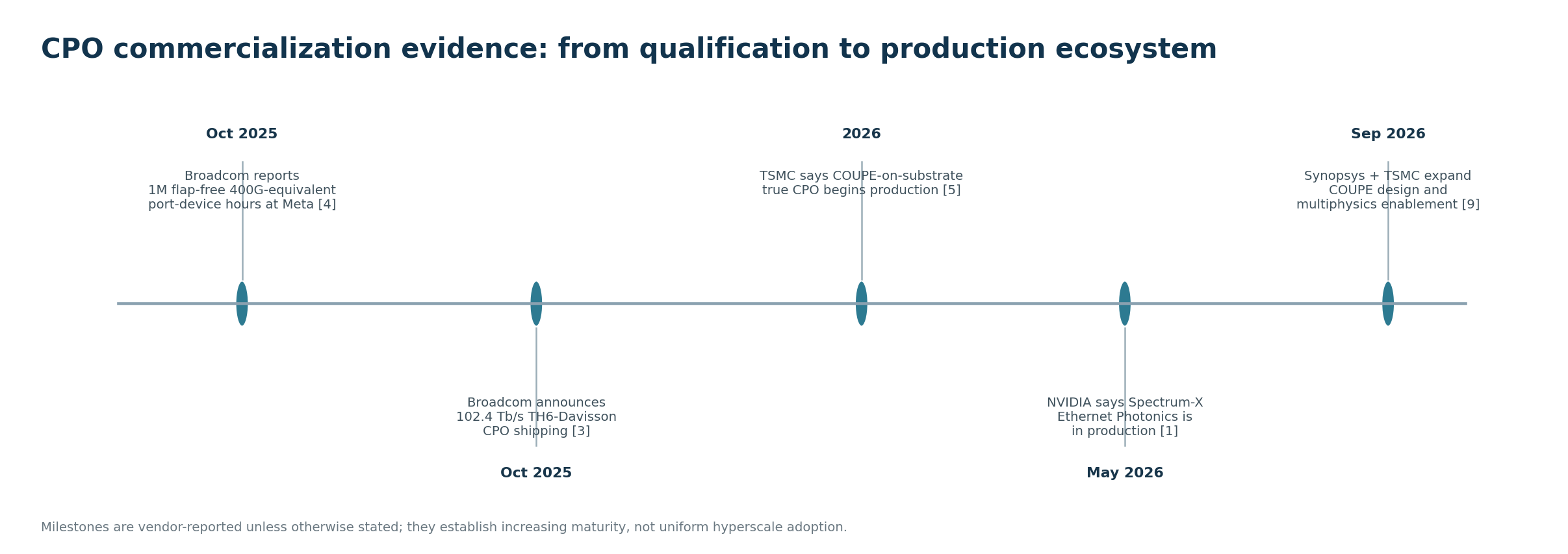
The answer is now “yes, but selectively.” NVIDIA said on May 31, 2026 that its Spectrum-X Ethernet Photonics switches, based on 200 Gb/s SerDes and co-packaged optics, were in production as part of the Vera Rubin platform. Broadcom has separately moved through multiple CPO generations; its 102.4 Tb/s BCM78919 supports 200G electrical lanes and is listed as Limited Release, while the company has also announced shipping Tomahawk 6–Davisson CPO systems. [1][3]
That is a meaningful maturity change. CPO is no longer only a laboratory or standards discussion. Yet “in production” does not mean it has displaced front-panel pluggable optics across data centers. The more useful diligence question is whether tightly integrated optics can achieve repeatable yield, survive fleet-scale operation, remain serviceable, and interoperate as network architectures move toward 400 Gb/s per lane. Those are the proofs that determine whether CPO becomes a broad infrastructure layer rather than a premium solution for a small set of controlled deployments.
What changed: optics is moving from a module problem to a package problem
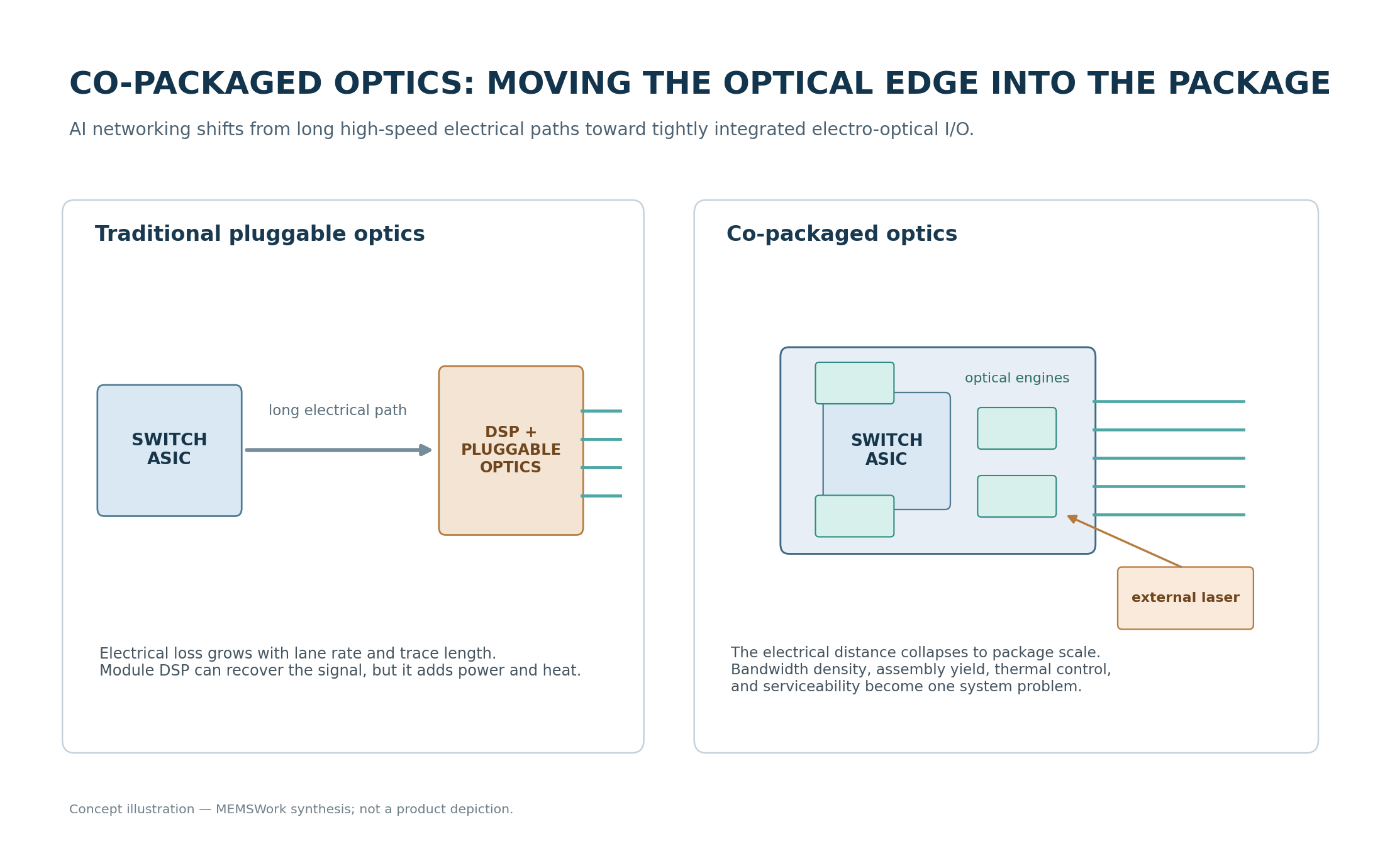
Traditional pluggable transceivers keep the optical module at the switch faceplate. The switch ASIC drives high-speed electrical signals across package escape routing, the printed-circuit board, connectors, and the module interface. As lane rates rise, channel loss grows and more equalization or retiming is needed. CPO shortens that electrical path by placing optical engines adjacent to the switch silicon, shifting more of the data movement into fiber earlier in the signal chain. Broadcom describes the same trade-off: at 212 Gb/s PAM4 and beyond, electrical loss raises the cost of compensating DSP, whereas CPO reduces path loss by integrating optics next to the ASIC. [11]
The architectural benefit is increasingly measurable. TSMC said at its 2026 North America Technology Symposium that its COUPE-on-substrate implementation would begin production in 2026 and would deliver 2× power efficiency and a 10× latency reduction versus a pluggable implementation on the circuit board. These are TSMC-reported comparisons, not universal system measurements, but they show why foundry roadmaps now treat silicon photonics as part of advanced integration rather than as a separate optical module. [5]
The next bottleneck is manufacturing and serviceability
CPO improves the electrical path by making the package more complex. An optical engine must be attached, aligned, tested, cooled, connected to fiber, and supported for the life of a high-value switch. A defect that would once have required replacing a pluggable module can become a package or board-level service event unless the architecture deliberately preserves replaceable elements.
NVIDIA’s manufacturing approach illustrates how the industry is attacking that risk. Its Spectrum-X CPO design uses solder-reflow-compatible optical engines that can be screened before attachment, plus detachable fiber connectors intended to enable automated fiber attachment late in assembly. NVIDIA reports a 409.6 Tb/s SN6800 switch configuration with 512 ports of 800 Gb/s or 2,048 ports of 200 Gb/s. The technical significance is not only bandwidth; pre-assembly test and detachable optical interfaces are attempts to keep known-good-component logic and serviceability inside an increasingly integrated product. [2]
Design tooling is also moving upstream. On September 23, 2026, Synopsys and TSMC announced expanded enablement for TSMC-COUPE together with unified multiphysics signoff. That matters because CPO couples signal integrity, optics, thermal behavior, power integrity, package stress, and manufacturing tolerance. The design flow must model those domains together if volume yield is to match the promise of shorter electrical reach. [9]
Reliability is a fleet-economics variable, not a component specification
Optics reliability becomes more demanding when many optical engines are integrated into one switch. OIF’s co-packaging framework explicitly warns that failure rates typical of pluggable modules cannot simply be multiplied across a dense CPO system. In its 51.2 Tb/s example, OIF uses targets of 10 FIT for each 3.2 Tb/s optical engine and 50 FIT for each 3.2 Tb/s laser source, with a six-year service-life target; it also notes that redundancy or degraded-throughput modes may be required to achieve acceptable system availability. [7]
Vendor evidence is improving but should be read carefully. Broadcom reported in October 2025 that a Meta test accumulated one million 400G-equivalent port-device hours without a link flap in a high-temperature lab characterization environment, and it reported 65% lower optics power than pluggable modules. The milestone is useful because it addresses stability under a hyperscale operator’s test conditions, but it is not the same as independent multi-year field data across heterogeneous production networks. [4]
Evidence ladder: what current milestones establish
| Evidence | Current signal | What it establishes | What it does not establish |
|---|---|---|---|
| Vendor production | NVIDIA says Spectrum-X CPO is in production; Broadcom has shipping / limited-release 102.4T CPO. [1][3] | Manufacturing flow exists beyond prototype stage. | Broad, multi-vendor adoption or sustained fleet economics. |
| Foundry roadmap | TSMC COUPE-on-substrate production begins in 2026. [5] | A scalable foundry integration path is available. | Customer yield, cost, and field serviceability across designs. |
| Reliability test | Broadcom reports 1M flap-free 400G-equivalent port-device hours at Meta. [4] | Strong lab/hyperscale qualification evidence for one implementation. | Independent long-duration field behavior across architectures. |
| Standards / roadmap | Ethernet Alliance expects pluggables and CPO to coexist as 400G/lane hosts develop. [8] | CPO is part of the forward interface design space. | A single dominant form factor or interoperability model. |
Table 1. A diligence view of current CPO evidence. “Production” and reliability claims are attributed to the reporting organizations.
Power advantage: use system boundaries, not headline percentages
Power is the strongest economic argument for CPO, but comparison boundaries matter. A 2026 Journal of Lightwave Technology analysis found current CPO transceivers to be 23% more energy-efficient than linear pluggable optics (LPO) and 67% more efficient than DSP-based pluggables; when host SerDes energy was included, the reported advantage increased to 44% versus LPO and 69% versus DSP pluggables. The same study estimated switch-power reductions of 18% versus LPO and 36% versus DSP-based links. [6]
These results are more useful than a single vendor headline because they force the comparison to state what is inside the energy boundary. The strategic implication is that the advantage can grow as the electrical channel becomes harder to drive. It can also shrink if a deployment requires excess redundancy, difficult thermal management, low manufacturing yield, or costly service procedures. CPO economics therefore must be measured at the switch and network level—not only at the optical engine.
Reported 2026 energy comparison
| Comparison boundary | CPO vs. LPO | CPO vs. DSP pluggable |
|---|---|---|
| Transceiver energy-efficiency improvement | +23% | +67% |
| Including host SerDes | +44% | +69% |
| Estimated switch-power reduction | 18% | 36% |
Table 2. Reported relative improvements from the 2026 Journal of Lightwave Technology system-level comparison. Source: [6].
Why CPO will coexist with pluggables before it replaces them
The strongest case for CPO is where bandwidth density, power, and cluster uptime justify deeper integration. That does not make every front-panel optical module obsolete. Ethernet Alliance’s 2026 work on 400 Gb/s-per-lane signaling explicitly treats traditional PCB hosts, co-packaged copper, near-packaged copper, near-package optics, and CPO as part of the same future design space. It also assumes that pluggable optics and CPO will coexist rather than forcing one architecture. [8]
That coexistence is rational. Pluggables preserve replacement flexibility and a large supplier ecosystem. CPO can reduce electrical reach and power at the cost of tighter integration and a more coupled manufacturing flow. The adoption boundary will likely be workload-specific: the largest AI fabrics can justify system redesign earlier than conventional enterprise or edge networks.
Strategic implications: value migrates into the integration stack
For corporate strategists and investors, the opportunity is broader than “silicon photonics.” The bottleneck shifts toward the stack that converts photonic-device performance into a manufacturable, serviceable network product: optical-engine packaging, external laser sources, fiber attach and connector systems, known-good-engine test, thermal control, photonic wafer process control, optical/electrical co-design, multiphysics signoff, and high-volume assembly automation.
The common pattern is system scaling: performance is increasingly determined by the interfaces among expensive components, not by a single transistor metric. See MEMSWork’s advanced-packaging analysis and memory-bottleneck analysis for the adjacent constraints around heterogeneous integration, HBM, test, yield, and thermal management.
What to Watch Over the Next 12 Months
• Field reliability, not only lab hours. Look for disclosed link-flap rates, optical-engine failures, laser replacement rates, and service actions from operating fleets.
• Volume yield and known-good-engine strategy. Watch whether vendors publish evidence that optical engines can be fully screened before assembly and whether package yield remains economic at 100+ Tb/s switch density.
• Service architecture. Detachable fiber connectors, external laser modules, redundancy, degraded-throughput modes, and repair workflows will determine whether integration raises or lowers lifecycle cost.
• 400G-per-lane convergence. Track Ethernet Alliance and standards activity around electrical channel assumptions, modulation, FEC, validation tools, and where CPO versus pluggable optics is practical. [8]
• Foundry-to-EDA maturity. TSMC COUPE production and Synopsys/TSMC multiphysics enablement should be followed by customer tape-outs, qualification, and manufacturing evidence. [5][9]
• Adoption outside tightly controlled stacks. The strongest commercial signal will be repeatable deployment across multiple system vendors or hyperscalers, not only a vertically integrated reference architecture.
What Would Change the Thesis?
The current thesis is that CPO has crossed into early commercial production and is becoming strategically necessary for the highest-bandwidth AI fabrics, but broad adoption will be determined by manufacturability and lifecycle economics rather than optical performance alone.
The thesis would strengthen if: independent field data showed materially lower failure and interruption rates than pluggable networks at comparable bandwidth, while vendors demonstrated stable high-volume yield and straightforward component-level service.
The thesis would weaken if: LPO, improved pluggables, co-packaged copper, or other electrical/optical architectures preserved sufficient power and reach through the 200G-to-400G-per-lane transition without forcing a CPO integration penalty.
The thesis would reverse if: CPO package yield, laser/engine failure modes, thermal coupling, or repair cost produced a higher network-level total cost of ownership than modular alternatives despite better link-level power efficiency.
Takeaway
Co-packaged optics is reaching the point where the central question is no longer whether it can move data efficiently. Multiple suppliers now report production or shipping systems, foundry roadmaps include true CPO, and design tools are adapting to the coupled optical-electrical-thermal problem. The next proof is operational: yield, serviceability, reliability, interoperability, and network-level economics. If those metrics hold, CPO can become a critical second scaling path for AI networking. If they do not, the market will continue to favor a mixed architecture in which pluggable and near-package solutions absorb more of the bandwidth transition.
Sources and Methodology
Sources were prioritized toward primary vendor documentation, standards/industry bodies, and a peer-reviewed 2026 system-level power study. Vendor performance and production statements are explicitly treated as vendor-reported claims; they are not presented as independent fleet-wide measurements. Numerical claims in the article are tied to the numbered references below.
1. NVIDIA, “Vera Rubin Ramps Into Full Production,” May 31, 2026.
4. Broadcom, “Industry-Leading Quality and Reliability of Co-Packaged Optics,” Oct. 1, 2025.
5. TSMC, 2026 North America Technology Symposium announcement (COUPE-on-substrate roadmap).
7. OIF, “Co-Packaging Framework Document,” OIF-Co-Packaging-FD-01.0.
8. Ethernet Alliance, “Defining the Path to 400 Gbps-per-Lane Ethernet Signaling,” June 16, 2026.
9. Synopsys and TSMC, expanded AI systems / COUPE design enablement, Sept. 23, 2026.
10. Broadcom, OFC 2026 AI infrastructure portfolio, March 12, 2026.
11. Broadcom, Co-Packaged Optics technology overview.
12. Ethernet Alliance, 2026 Ethernet Roadmap.
Last Updated / Update History
October 1, 2026 — Initial publication. Thesis: CPO has entered early commercial production; the decisive next evidence is manufacturing yield, field reliability, serviceability, interoperability, and system-level economics.