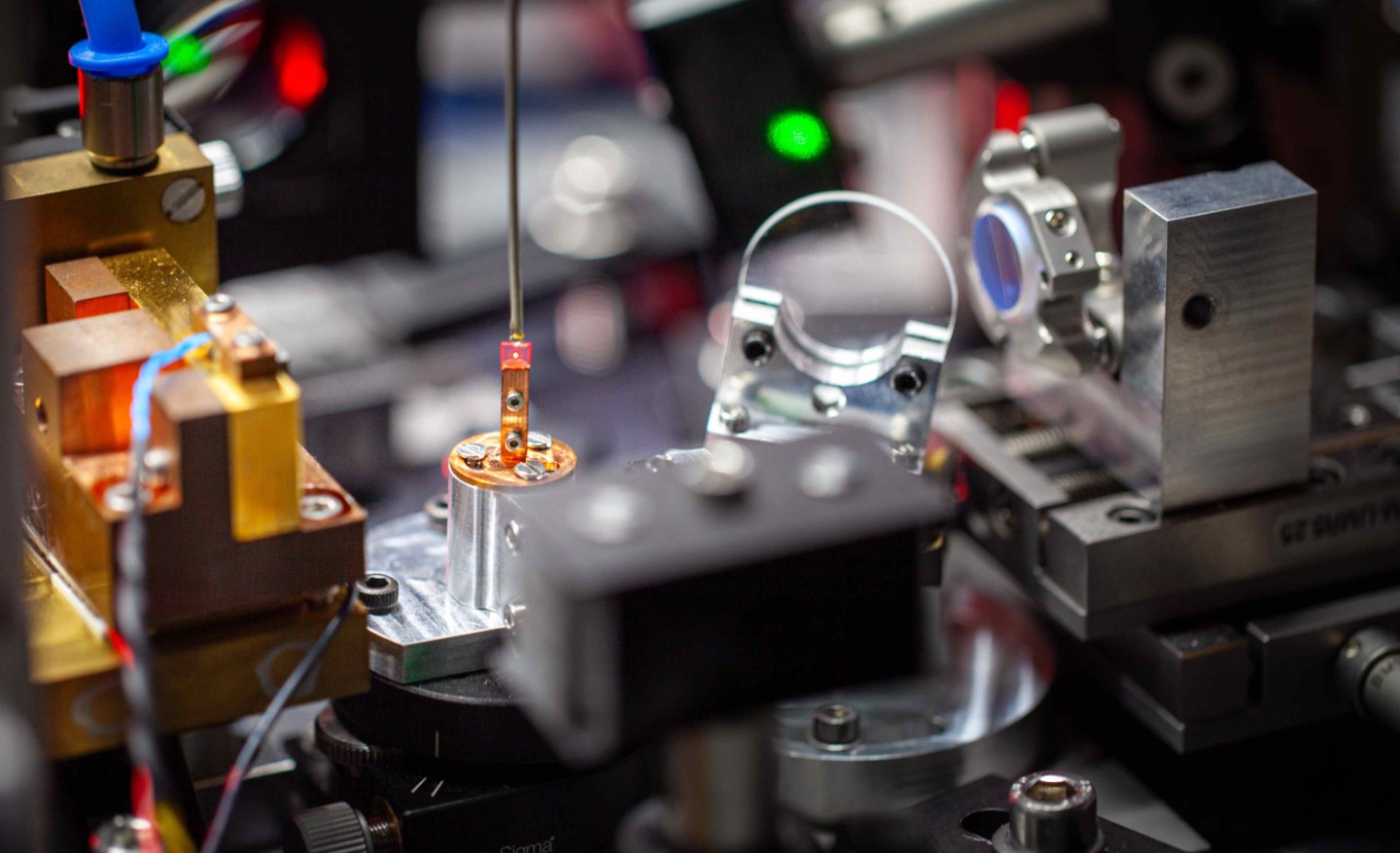
Laser-threshold diamond magnetometry research apparatus. © Fraunhofer IAF; reproduced in connection with its October 22 announcement. Source: [2].
Diamond Magnetometry: From Optical Contrast to Field Evidence
Laser-threshold diamond magnetometry has produced a compelling optical readout result. The next decision is whether that result can support a stable magnetic instrument in its intended environment. MEMSWork’s assessment is that measured noise, calibration burden and manufacturing repeatability now deserve more weight than optical contrast alone. Development partnerships are justified; claims of field-ready performance require additional evidence.
MEMSWork Intelligence Dashboard
| Field | Current assessment |
|---|---|
| Market status | Laboratory laser-threshold demonstration; a separate integrated NV-sensor development path also exists. [1] [6] |
| Primary or emerging constraint | Converting optical readout improvement into reproducible instrument sensitivity. |
| Demand driver | Magnetic sensing for biomagnetism, navigation and anomaly detection. [2] |
| Time horizon | Near-term prototype evaluation; commercial deployment timing remains uncertain. |
| Technologies to watch | NV-diamond readout, semiconductor laser cavities, flux concentrators and quantum process design kits. [1] [4] [5] |
| Strategic signal | Contract against application-level measurement results, with the full instrument boundary defined. |
| Next trigger | A calibrated noise spectrum and environmental stability results from a packaged system. |
The decision question: what does better readout buy?
Should a sensing team commit to laser-threshold diamond magnetometry now? The appropriate commitment is a staged development project with explicit acceptance criteria. A research result can justify that project without establishing a product specification. This distinction matters when an attractive sensitivity headline begins to influence instrument architecture, customer promises or investment valuation.
The fresh development is Schall and colleagues’ paper published on October 22, 2026. An NV-doped diamond acts as a magnetic-field-dependent absorber inside a semiconductor laser cavity. Near the lasing threshold, changes in absorption strongly alter the output. The researchers demonstrate optical switching and vector operation, but explicitly distinguish a calculated sensitivity limit from actual sensitivity in measurements. [1]
What changed: the laser becomes the readout
Fraunhofer describes the approach as reading the laser signal rather than collecting the NV centers’ fluorescence. That architectural change makes the optical cavity part of the sensing function. Its announcement identifies biomagnetic measurements, magnetic navigation and anomaly detection as potential applications, rather than established deployments of the new apparatus. [2]
The strategic opportunity is therefore specific: investigate whether a stronger readout can reduce the burden of extracting useful magnetic information. The engineering obligation is equally specific: demonstrate that gain in the complete instrument, including the controls needed to maintain its operating point. A component-level result should become a testable system hypothesis.
| Evidence | Reported result or status | Interpretation |
|---|---|---|
| Optical contrast | 100%; laser output can be extinguished at resonance. [1] | Strong readout discrimination; not magnetic accuracy. |
| Optical output | Up to 50 mW. [1] | Output light; not electrical power consumption. |
| Sensitivity | Calculated photon-shot-noise limit below 400 fT/√Hz for each vector component. [1] | A fundamental limit; not achieved instrument noise. |
| Integrated sensing | Separate compact NV-magnetometer prototype announcement. [6] | Evidence of integration work; not this cavity’s packaged performance. |
| Manufacturing pathway | DIREQT targets pilot-line processes and quantum process design kits. [5] | An industrialization program; not qualified volume supply. |
Table 1. Evidence boundaries for laser-threshold diamond magnetometry. Reported results and program status are sourced individually; interpretation is MEMSWork synthesis. Sources: [1] [5] [6]. Rows are not matched performance comparisons.
Diamond Magnetometry: From Optical Contrast to Field Evidence
A sensitivity limit is not a measured noise floor
The paper warns that technical noise in laser systems can exceed the fundamental limit substantially, and states that its reported sensitivity limits have not been achieved as actual measurement sensitivities. That qualification should travel with the result whenever it appears in a presentation, procurement brief or financial model. [1]
Barry and colleagues’ foundational review identifies spin dephasing, readout fidelity and diamond material properties as important routes to improved ensemble-NV sensing. It also documents the gap between practical devices and theoretical limits. Better optical discrimination addresses an important part of that problem, but should not be treated as resolving every source of measurement uncertainty. [3]
For evaluation, MEMSWork recommends requesting the measured noise spectrum alongside calibration data, bandwidth, magnetic bias conditions and acquisition method. Add stability over the intended measurement duration, recovery after a field disturbance, temperature dependence and repeatability after realignment. State which results require shielding or active compensation. These are proposed acceptance tests, not capabilities established by the new paper.
Compare complete architectures against the same task
Fescenko and colleagues demonstrated another route: adding ferrite flux concentrators to a diamond magnetometer and using dual-resonance measurements to suppress thermal shifts. The work illustrates that improvements can also come from the magnetic interface and measurement protocol. It is a different experiment, not a directly interchangeable baseline for the new laser cavity. [4]
A useful comparison begins with the customer’s task. Does the instrument need vector information, local spatial resolution, tolerance of a large background field, or rapid detection of a transient? Define those requirements before ranking sensitivity figures. A highly favorable result under a narrow test condition may have limited value if the application requires a different operating regime.
For a corporate team, the next experiment should compare complete instruments on the same calibrated field sequence. Include power supplies, optical pumping, microwave electronics, thermal management and processing. This follows the boundary discipline in MEMSWork’s sensor energy-budget analysis: report the resources required to obtain a useful observation.
Manufacturing: qualify the coupled assembly
Fraunhofer’s earlier compact NV-magnetometer announcement shows that integration is already a research direction. It describes prototype sensor heads and optional water cooling, while presenting further size reduction as a goal. Those results concern a separate system and cannot be combined with the new cavity’s optical performance to imply a single compact instrument. [6]
The proposed production unit for diligence should be an accepted sensing assembly. Ask suppliers which characteristics are controlled at diamond receipt, after optical assembly and after calibration. Request a plan for separating material variation from alignment and control variation. The most valuable evidence would connect those measurements to acceptance yield, rework and serviceability.
Europe’s DIREQT program aims to establish a diamond quantum pilot line, including process design kits, testing and experimentation facilities, and an open-access framework. That is a relevant ecosystem signal, but the stated objectives do not prove that a laser-threshold magnetometer process is available or qualified. [5]
The implication is to map responsibilities across materials, optical assembly, control electronics and application validation. MEMSWork’s supplier-qualification analysis provides a related framework: a strong component supplier does not automatically resolve interfaces between suppliers.
Commercial strategy: fund the next uncertainty
A sensible partnership would tie funding to a measured application result and the reproducibility of that result after assembly. Budget explicitly for calibration, environmental testing and instrument support. Avoid valuing the project as though laboratory readout performance already guarantees customer savings or revenue.
For entrepreneurs, the defensible product could lie in stable optical packaging, calibration methods, noise suppression or an application-specific measurement workflow. These are opportunities to investigate, not claims about available intellectual property. Customer discovery should establish whether the prospective buyer needs better sensitivity or instead needs easier operation, smaller infrastructure and more reliable decisions.
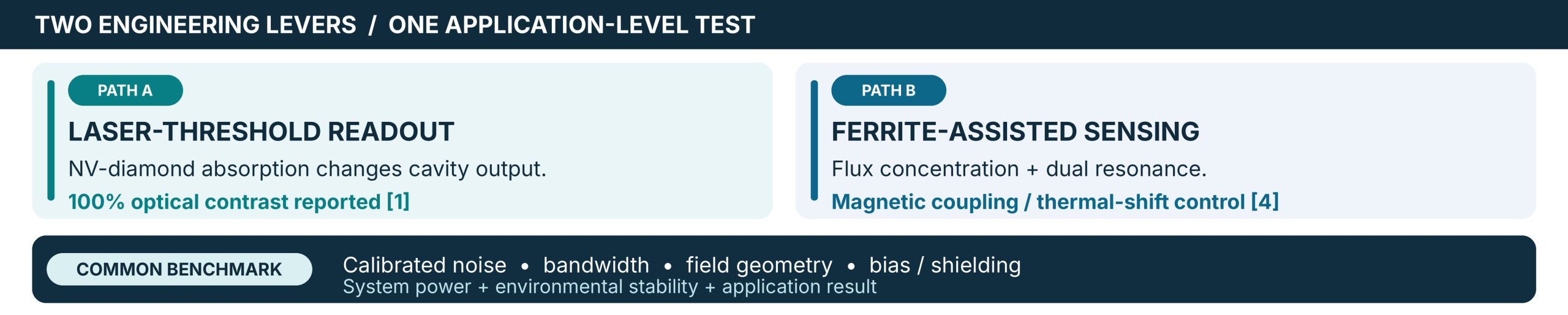
Figure 1. Two distinct routes to better NV-diamond sensing: laser-threshold optical readout [1] and ferrite-assisted magnetic coupling with dual-resonance [4]. The shared full-instrument benchmark is a MEMSWork recommendation, not a published head-to-head comparison.
What to Watch Over the Next 12 Months
Measured instrument performance: watch for noise spectra, repeatable calibration and documented environmental conditions from the laser-threshold team. Evidence from independent operators would be especially useful. A comparison should preserve bandwidth and measurement geometry rather than selecting the most favorable headline from each apparatus.
Integration and supply: watch whether packaged cavity demonstrations retain useful performance after transport and thermal cycling. Track DIREQT’s public access offerings and process documentation against its stated pilot-line objectives. [5] Separately, ask whether component acceptance criteria translate into repeatable assembled results.
Customer evidence: look for a defined measurement task, a named validation partner where disclosure is permitted, and a comparison with the instrument already used for that task. A paid evaluation would be informative; it would still need technical results to establish differentiation.
What Would Change the Thesis?
The thesis would strengthen if a packaged instrument demonstrated a reproducible application advantage with its total power, calibration effort and environmental conditions disclosed. It would weaken if practical noise remained dominant, operating-point control required excessive infrastructure, or an alternative architecture delivered the same task more economically.
A further revision would be necessary if manufacturing variation made calibration or replacement impractical. Conversely, repeatable assembly with predictable acceptance and service procedures would shift attention toward customer adoption. The decisive evidence is the measurement a customer can rely on, produced by an instrument a supplier can repeatedly deliver.
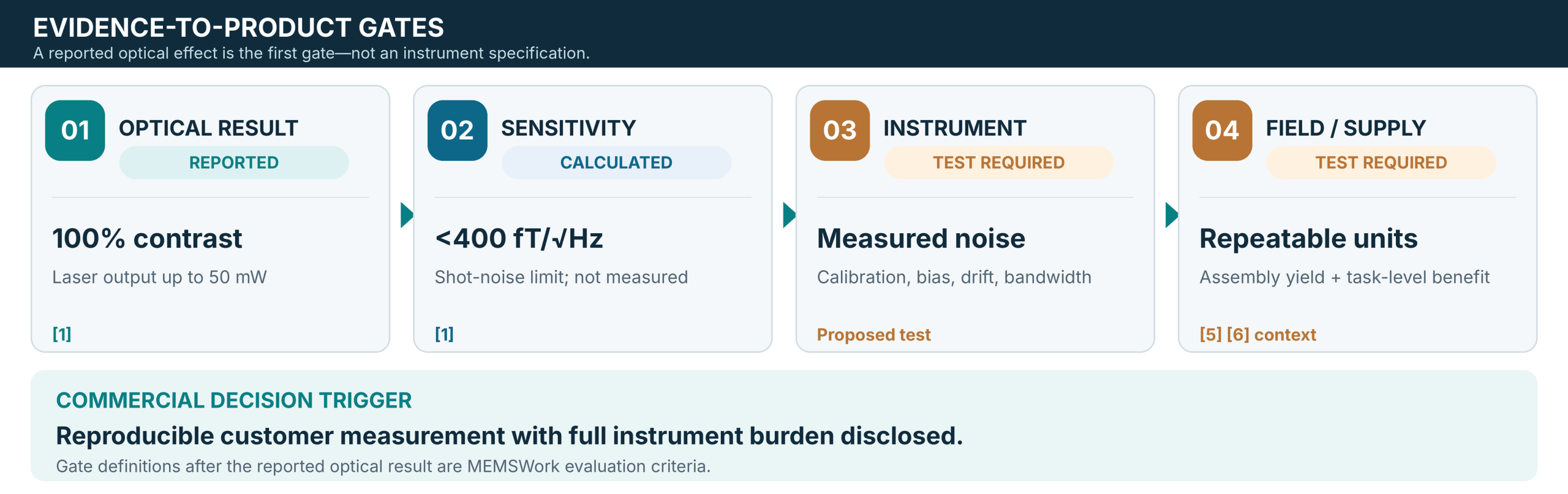
Figure 2. Evidence gates from laboratory optical behavior to repeatable field performance. Reported contrast and calculated limits are from [1]; integration and industrialization context is from [5] [6]. Additional test criteria are MEMSWork recommendations, not demonstrated results.
Sources and Methodology
Primary research and institutional disclosures are separated from MEMSWork’s proposed tests and commercial interpretation. No market-size forecast, deployment schedule or cost saving is inferred. The evidence table preserves the distinction between demonstrated optical behavior, calculated limits, separate prototypes and manufacturing-program objectives.
[2] Fraunhofer IAF, laser-threshold magnetometry announcement, October 22, 2026.
[5] European Commission CORDIS, DIREQT project objectives and funding record.
[6] Fraunhofer IAF, Miniaturized quantum magnetometer, June 18, 2025.
Last updated: October 30, 2026. Update history: Initial publication; future material revisions will identify changes in evidence and thesis.