Humanoid Robotics’ Commercial Proof Test: From Demos to Durable Revenue
The humanoid-robotics market has entered a more demanding phase. Shipments and demonstrations still matter, but investors and industrial customers increasingly need evidence of independent demand, sustained factory runtime, repeatable throughput, safety and viable service economics.
Around 7,000 humanoid robots were sold worldwide in 2025 for industrial and professional-service uses, according to data compiled by the International Federation of Robotics (IFR). That is an early market, not yet a mass-deployment market: it compares with about 542,000 conventional industrial robots installed in 2024 and an estimated 199,000 professional-service robots sold that year. IFR also cautioned that many of the humanoids purchased in 2025 went to research organizations or AI-training programs rather than directly into productive work [1].
The distinction has become financially important. Reuters reported on September 21, 2026 that Chinese regulators were slowing some humanoid-robot IPO approvals while examining whether valuations and revenue tied to government-backed data-collection centers reflected durable commercial demand. The report described a sector-specific slowdown rather than a formal ban, but its message reaches beyond China: the next valuation step will depend less on choreographed demonstrations and more on evidence that robots can perform useful work repeatedly, safely and economically [2].
The market is moving from spectacle to scrutiny
Humanoid robotics attracts capital because its form factor promises flexibility in spaces designed around people. A bipedal or human-scale robot can potentially use existing aisles, racks, tools and workstations without the extensive redesign required by fixed automation. That potential is real, but it does not eliminate the operational burden of qualifying a new machine for production.
China’s reported IPO slowdown exposes a broader diligence problem: a purchase order is not automatically proof of end-user demand. Reuters reported that some robot data centers and joint ventures received 80% to 90% of their initial investment from local governments. An investor close to the sector estimated that valuations at some companies could fall 60% to 70% if revenue associated with data centers were excluded. These are reported estimates, not audited sector-wide findings, but they show why customer identity, funding source and repeat demand matter as much as headline order value [2].
The IFR’s 2026 outlook makes the engineering test equally clear. Humanoids must compete with established automation on cycle time, energy consumption, maintenance cost, durability and safety. Dexterity and mobility create opportunity, but factory buyers ultimately purchase reliable throughput and an acceptable total cost of ownership [3].
What counts as commercial proof
Commercial maturity is better treated as an evidence ladder than as a binary label. A robot can be technically impressive and still sit several steps away from a repeatable business.
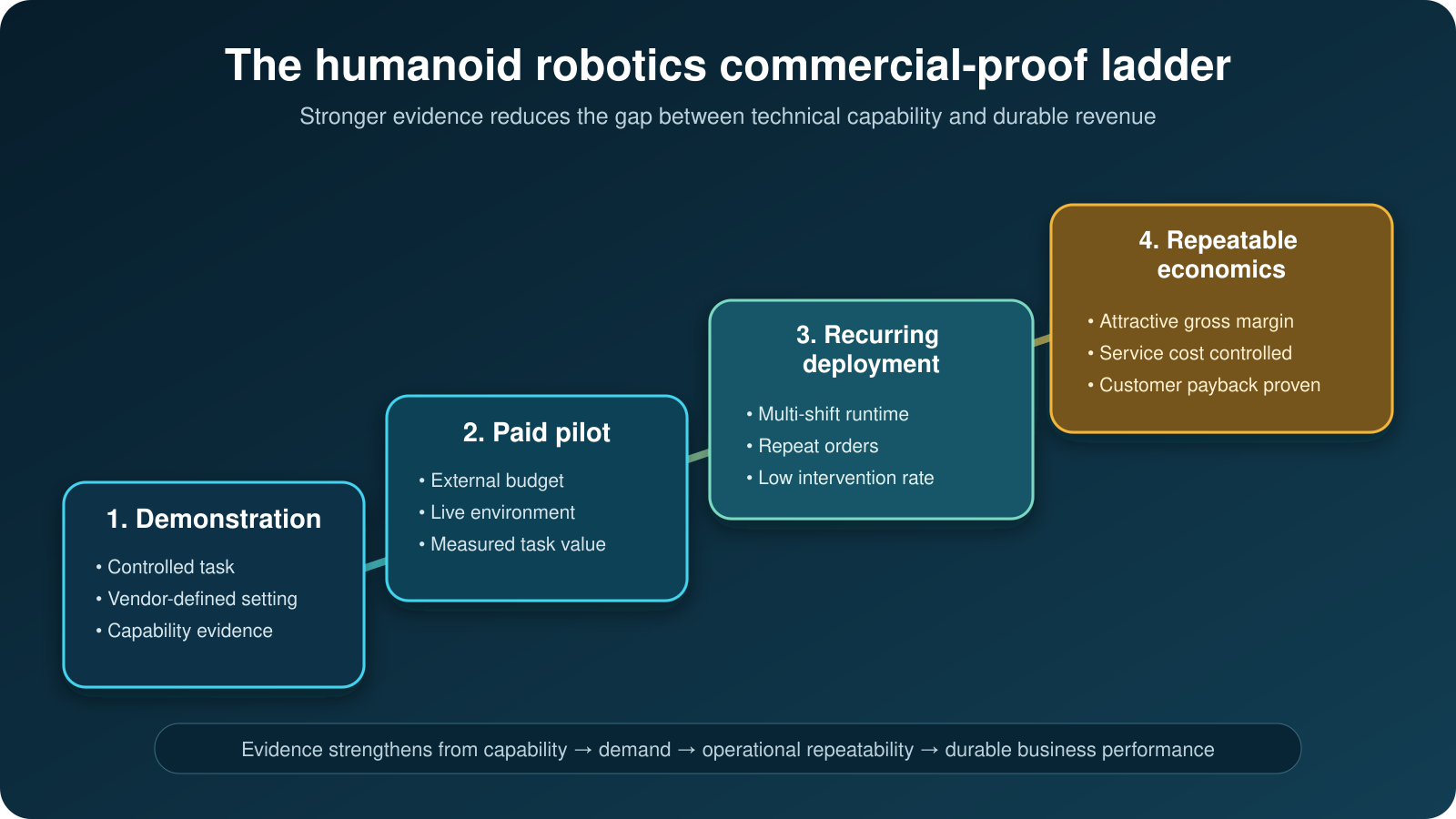
Figure 1. The commercial-proof ladder for humanoid robotics. Moving from a demonstration to durable revenue requires progressively stronger evidence: paid use, sustained operation, repeat purchases and repeatable unit economics. Original MEMSWork synthesis based on IFR deployment criteria and disclosed company operating metrics [1][3][4][5].
The first level is a controlled demonstration: useful for showing capability, but weak evidence of customer value. A paid pilot is stronger because an external organization commits budget and exposes the system to a real environment. Recurring deployment requires sustained operation across shifts, measurable throughput, acceptable intervention rates and a customer willing to expand or renew. The highest level is repeatable economics: gross margin, maintenance burden, deployment labor, utilization and customer payback remain attractive as the fleet grows.
This framework complements MEMSWork’s analysis of robot data factories and the infrastructure required for Physical AI. Training data can improve capability, but commercial proof appears only when the resulting system performs useful work under customer operating constraints.
Deployment evidence is becoming measurable
Several developers now disclose operational metrics that make comparison more useful, although the disclosures are not yet standardized and most remain company-reported.
| Company | Disclosed evidence | Commercial-proof stage | What remains unclear |
|---|---|---|---|
| Agility Robotics | More than 65,000 operating hours across commitments at nine customer facilities; more than $300 million in multi-year Digit v5 orders, subject to contractual milestones; more than 100,000 totes moved at GXO [4][5] | Recurring commercial deployment with contracted expansion | Realized revenue, fleet-level utilization, gross margin, service cost and customer payback |
| Figure | Figure 02 ran 10-hour weekday shifts at BMW, loaded more than 90,000 parts over 1,250 operating hours and contributed to more than 30,000 vehicles; Figure reported more than 350 Figure 03 units produced by April 2026 [6][7] | Sustained deployment plus manufacturing ramp | Number of revenue-producing units, external customer concentration, realized economics and intervention rate at fleet scale |
| UBTECH | The company reported 1,079 full-size humanoid robots sold in 2025 and approximately RMB820 million in related revenue, about 41% of total revenue [8] | Product revenue at meaningful early volume | Customer mix, government-supported demand, repeat orders, deployment utilization and segment profitability |
| Apptronik | Commercial agreement with Mercedes-Benz to pilot Apollo in manufacturing logistics; Apollo is specified at 5 feet 8 inches, 160 pounds and a 55-pound lifting capacity [9] | Commercial pilot | Paid fleet size, runtime, throughput, repeat orders and unit economics |
Table 1. Publicly disclosed evidence varies widely across humanoid-robot developers. Metrics are company-reported unless otherwise noted and should not be treated as directly comparable without consistent definitions. Sources: Agility Robotics [4][5], Figure [6][7], UBTECH [8], and Apptronik [9].
Agility provides the clearest disclosed bridge from pilot to contracted deployment. Its June 2026 transaction announcement cited more than 65,000 operating hours, commitments across nine customer facilities and more than $300 million in multi-year Digit v5 orders, subject to contractual milestones. A separate deployment update reported that Digit had moved more than 100,000 totes at GXO. Those metrics do not disclose profitability, but they are materially stronger than a one-day demonstration because they measure activity in live workflows [4][5].
Figure’s BMW deployment offers a different form of proof. The company reported that Figure 02 ran 10-hour shifts Monday through Friday, loaded more than 90,000 sheet-metal parts during 1,250 operating hours and contributed to production of more than 30,000 vehicles. Its operational targets included an 84-second cycle, greater than 99% placement success per shift and zero human interventions per shift. Figure did not disclose complete results against every target, but the publication of task-level metrics is the type of evidence industrial buyers need [6].
Manufacturing scale is a separate test. Figure reported in April 2026 that it had produced more than 350 Figure 03 robots, demonstrated a one-robot-per-hour cycle time, achieved more than 80% end-of-line first-pass yield and produced more than 9,000 actuators. These figures show progress in production engineering, but manufacturing capacity should not be confused with customer utilization or profitable demand [7].
UBTECH’s 2025 annual report shows that early humanoid revenue can reach material scale. The company reported 1,079 full-size humanoid robots sold and approximately RMB820 million in related revenue, representing about 41% of total revenue [8]. The next diligence questions concern the composition of that demand: how much came from independent industrial customers, how many robots entered productive workflows, and whether customers reorder after initial deployments.
Why factory runtime matters more than shipment counts
A shipped robot may be used for research, data generation, demonstrations or productive labor. The economic value depends on utilization after delivery. A useful diligence package should therefore connect shipment data to task-level operating data.
For logistics and manufacturing, the most important measures include cycle time, successful cycles per shift, intervention frequency, uptime, mean time between failures, maintenance hours, energy per completed task and the labor required to integrate each new site. Safety must be treated as a scaling constraint rather than a compliance footnote. IFR notes that AI-driven autonomy complicates validation and oversight, while industrial use requires alignment with applicable safety standards and clearly defined liability [3].
The software layer also matters. Fleet orchestration, device interfaces, audit logs and bounded authority determine whether a robot can be integrated into enterprise operations. MEMSWork’s discussion of Anthropic’s Model Hardware Standard reaches the same architectural conclusion: AI can plan and adapt, but deterministic controls, permissions and safety systems must remain explicit at the machine boundary.
A practical diligence framework for investors and corporate buyers
The strongest commercial evidence will combine five categories.
- Independent demand. Identify the end customer, funding source and decision owner. Separate government-supported training-center purchases, related-party transactions and research units from independently budgeted production deployments.
- Operational value. Require task-level throughput, quality, uptime and intervention data over multiple shifts. A short pilot can reveal feasibility; it cannot establish lifecycle economics.
- Repeatability. Look for expansion at the same customer and successful deployment of the same platform across multiple facilities. Each site should require less custom engineering as the product matures.
- Service economics. Track gross margin together with installation labor, field support, spare parts, battery replacement, software operations and warranty reserves. Hardware revenue can grow while service burden destroys margin.
- Safety and governance. Verify the applicable certification path, risk assessment, incident reporting, cybersecurity controls and assignment of responsibility between the robot vendor, integrator and site operator.
These measures will also improve competitive analysis. A company with fewer robots but high utilization, low intervention rates and repeat orders may have stronger commercial evidence than a company with larger shipments concentrated in research or subsidized data centers.
What to watch next
The sector is entering a period in which disclosure quality should improve. Investors and corporate strategists should watch for:
- conversion of pilots into multi-site contracts;
- disclosed fleet utilization and customer-renewal rates;
- consistent definitions for runtime, autonomous hours and human interventions;
- realized revenue against announced order backlogs;
- gross margin after installation and field-service costs;
- safety certification and incident data for collaborative operation;
- evidence that new tasks can be deployed without a proportional increase in engineering labor; and
- customer payback measured against conventional automation and human-operated alternatives.
The reported slowdown of humanoid IPO approvals in China is therefore not evidence that the technology thesis has failed. It is evidence that the capital-market test is becoming more specific. The market is beginning to distinguish robots that can perform from businesses that can deploy, support and earn durable revenue from those robots.
Takeaway
Humanoid robotics has moved beyond the stage where capability videos alone define progress. The 7,000-unit global sales baseline, limited factory fleet sizes and growing scrutiny of subsidized demand show that commercialization remains early. At the same time, disclosed operational evidence from Agility, Figure and others shows that productive deployments are becoming measurable.
The next leaders will not be determined only by walking speed, dexterity or model sophistication. They will be determined by independent demand, sustained runtime, safe integration, repeat orders and service economics. For investors and corporate buyers, that is the commercial proof test that now matters.
References
- Reuters, “Humanoid robot sales tally hit 7,000 globally last year,” September 21, 2026. https://www.reuters.com/technology/humanoid-robot-sales-tally-hit-7000-globally-last-year-2026-09-21/
- Reuters, “China slows humanoid robot IPO rush as hype outruns reality,” September 21, 2026. https://www.reuters.com/business/finance/china-slows-humanoid-robot-ipo-rush-hype-outruns-reality-2026-09-21/
- International Federation of Robotics, “Top 5 Global Robotics Trends 2026,” January 8, 2026. https://ifr.org/ifr-press-releases/news/top-5-global-robotics-trends-2026
- Agility Robotics, “Agility Robotics to Go Public Through Merger with Churchill Capital Corp XI,” June 24, 2026. https://www.agilityrobotics.com/content/agility-robotics-to-go-public-through-merger-with-churchill-capital-corp-xi
- Agility Robotics, “Digit Moves Over 100,000 Totes in Commercial Deployment,” November 20, 2025. https://www.agilityrobotics.com/content/digit-moves-over-100k-totes
- Figure, “F.02 Contributed to the Production of 30,000 Cars at BMW,” November 19, 2025. https://www.figure.ai/news/production-at-bmw
- Figure, “Ramping Figure 03 Production,” April 29, 2026. https://www.figure.ai/news/ramping-figure-03-production
- UBTECH Robotics, Annual Report 2025, April 21, 2026. https://owebsite-cdn.ubtrobot.com/resources/file/2026/04/21/797179114676293.pdf
- Apptronik, “Apptronik and Mercedes-Benz Enter Commercial Agreement,” March 15, 2024. https://apptronik.com/news-collection/apptronik-and-mercedes-benz-enter-commercial-agreement