Robot Data Factories: The Missing Infrastructure for Physical AI
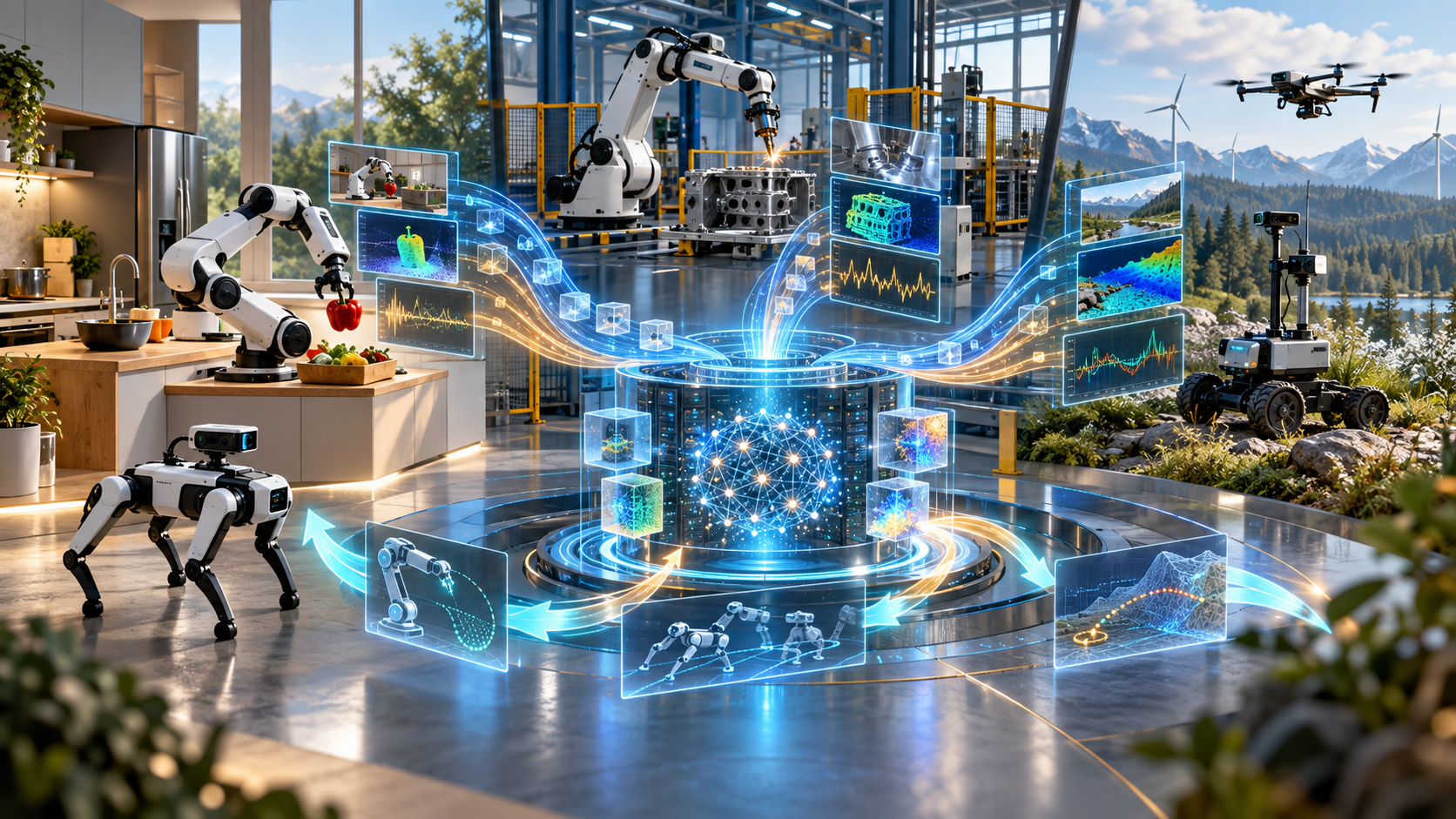
Physical AI may be constrained less by model size than by the supply of validated robot experience. A new infrastructure concept—the robot data factory—could turn every deployment into a repeatable learning loop.
Generative AI learned from an internet-scale stock of text, images and video. Robots face a harder problem: the most valuable training data does not already exist. It must be produced through physical interaction, with the right sensors, calibration, action labels and outcome checks. A camera recording of a gripper is not enough. A learning system needs to know what the robot was asked to do, what it sensed, which command it issued, what happened next and whether the result was safe and useful.
That gap is why robot data factories are emerging as a strategic layer for physical AI. The phrase comes from a September 2026 preprint led by Sami Haddadin, which proposes treating “robot experience” rather than raw data as the core resource. The paper is a framework, not yet an industry standard, but it names an increasingly visible requirement: robots need an industrial system for generating, validating, organizing and reusing experience.
Why robot data is different
Language models can learn from static records. Robot policies must learn a closed-loop relationship among perception, action and consequence. The same instruction—“pick up the cup”—changes with camera position, gripper geometry, friction, lighting, clutter, latency and the cup itself. A successful trajectory on one platform may be unusable on another unless the dataset preserves embodiment and calibration metadata.
Scale alone therefore does not solve the problem. Diversity, synchronization and verifiable outcomes matter. The DROID project illustrates the operational burden: its open manipulation dataset contains 76,000 demonstrations and 350 hours of interaction, collected across 564 scenes and 86 tasks by 50 data collectors over 12 months. The project standardized hardware across 13 institutions and later released improved camera calibration for 36,000 episodes. The calibration update is not a footnote; it shows that data quality is an ongoing engineering function.
From dataset to factory
The Robot Data Factory framework organizes work from missions and tasks down to skills, episodes, datasets, benchmarks and measured capabilities. Its proposed operating cycle is simple: deploy, measure, learn and repeat. The important shift is organizational. Data collection becomes a permanent production capability rather than a one-off research campaign.
In practice, a factory would combine real robot runs, simulation and synthetic augmentation with synchronized video, depth, force, proprioception, actions, language instructions and external ground truth. Each episode would carry provenance, calibration status, failure labels and safety context. Benchmarks would evolve as deployments reveal new edge cases, while controlled feedback sends improved policies back to robots.

This is complementary to the Model Hardware Standard discussed previously by MEMSWork. MHS addresses how AI agents communicate with instruments and machines. A robot data factory addresses how those machines generate trustworthy experience for learning and evaluation. One is an interface layer; the other is an experience-production layer.
The building blocks are arriving
Several projects already supply pieces of this architecture. Google DeepMind’s Open X-Embodiment pooled more than 1 million real-robot trajectories from 60 datasets and 34 laboratories, spanning 22 robot embodiments. The associated project reports 527 skills and 160,266 tasks. Its significance is not only size; it demonstrated that heterogeneous robot data can be converted into a shared format and used to train cross-embodiment models.
Physical Intelligence’s π0.5 work offers another signal. Its approach co-trains on robot action data, high-level semantic labels, verbal instructions and web data. In the company’s experiments, generalization improved as the number of training environments increased, approaching an in-environment baseline after roughly 100 training environments. The reported result is experimental, but it reinforces a crucial design principle: coverage across settings and embodiments can be more valuable than repetition in one lab.
Synthetic data will be part of the mix, although it cannot replace physical validation. NVIDIA reported that its GR00T pipeline generated 780,000 synthetic trajectories—equivalent to 6,500 hours of human demonstration—in 11 hours, and that combining synthetic and real data improved performance by 40% over real data alone in its tests. Those are vendor-reported results, but they show why simulation, world models and scenario generation are becoming factory equipment.
Standardized storage and low-cost capture matter just as much. LeRobotDataset v3 defines a scalable format for multimodal time series, camera streams, sensorimotor signals and relational metadata, designed to stream datasets with millions of episodes. Hugging Face’s open Grabette system attacks the input cost: its published bill of materials is about €490 for the handheld recorder and €120 for its gripper add-on, allowing human demonstrations to be captured without a full robot setup.
Five layers of robot data infrastructure
| Layer | Function | Strategic bottleneck |
|---|---|---|
| Capture | Real, simulated and human demonstrations | Coverage, cost and safety |
| Semantics and metadata | Synchronize state, action, video and context | Cross-platform normalization |
| Validation | Ground truth, calibration, failure labels and provenance | Quality and reproducibility |
| Training and evaluation | Train policies and maintain living benchmarks | Generalization and benchmark leakage |
| Deployment flywheel | Run locally, log outcomes and feed controlled updates | Governance, rights and operations |
Where value may accumulate
If robot data becomes industrial infrastructure, value will migrate beyond model developers. Sensor synchronization, calibration, teleoperation tools, simulation, dataset formats, safety evaluation and fleet operations all become strategic control points. The opportunity resembles the broader AI infrastructure stack described in MEMSWork’s analysis of the AI memory bottleneck: progress at the model layer exposes constraints in adjacent hardware and data systems.
The most defensible assets may be neither raw recordings nor a single foundation model. They may be high-quality experience pipelines tied to valuable environments: manufacturing cells, laboratories, energy assets, hospitals, farms and field inspection. Operators that can collect rare failures safely, label outcomes consistently and redeploy improvements quickly will possess a compounding advantage.
On-device inference strengthens that loop. Google DeepMind says Gemini Robotics On-Device can be adapted with as few as 50 to 100 demonstrations and operate without a data network. Local execution reduces latency and connectivity dependence, while selective upload can keep sensitive raw data inside a facility. The factory may therefore be distributed: collection and inference at the edge, with governance, aggregation and heavier training coordinated centrally.
The constraints are substantial
The factory metaphor should not obscure the hard parts. More experience can amplify systematic bias if sensors are miscalibrated or success criteria are weak. Simulation can cheaply create coverage but still suffer from the sim-to-real gap. Proprietary robot logs raise questions about worker privacy, site security, data ownership and liability. Benchmarks can leak into training mixtures, and a policy that scores well on average can still fail catastrophically in a rare physical state.
Interoperability also remains incomplete. Common formats help, but robots differ in kinematics, control rates, sensors and safety envelopes. Action tokenization does not automatically make an episode transferable. External ground truth, traceable transformations and embodiment-aware evaluation will be required if organizations want to compare capabilities rather than just datasets.
What executives and investors should watch
- Experience yield: how many validated, novel learning episodes a fleet produces per operating hour.
- Cross-embodiment transfer: whether new data improves other robot types without expensive re-collection.
- Calibration and provenance: whether every episode can be traced to sensor state, software version and validation method.
- Closed-loop improvement: how quickly deployment failures become corrected policies under controlled review.
- Rights and governance: who can train on operational data and where raw recordings are allowed to move.
The immediate opportunity is not to build one giant warehouse of robot video. It is to build a reliable production system for experience. The organizations that industrialize that loop—capture, validate, train, evaluate and redeploy—will determine how quickly physical AI moves from impressive demonstrations to dependable operations.