
Conceptual wide-parallel optical interconnect. Original MEMSWork illustration; not a named product or an exact device geometry.
Micro-Emitter Optics Face the Interoperability Test
Micro-emitter optical interconnects offer a different route to AI networking: distribute bandwidth across many modest-speed optical channels. Recent product and standards announcements make the approach commercially relevant, but the decisive evidence concerns interoperable connectors, complete-link power and behavior when channels fail. Buyers should qualify a serviceable link and its operating assumptions before extrapolating device efficiency into infrastructure savings.
MEMSWork Intelligence Dashboard
| Field | Current assessment |
|---|---|
| Market status | Evaluation hardware and announced product roadmaps; broad deployment is not established. [3,5] |
| Primary constraint | Preserving optical alignment, useful bandwidth and fault response across a dense parallel interface. |
| Demand driver | AI connections requiring greater reach with manageable networking power. [1,3] |
| Time horizon | Credo targets cable shipments in 2027; its SRMO specification announcement targets OCP approval in 2027. Both remain forward-looking. [1,3] |
| Technologies to watch | Micro-emitter arrays, imaging or multicore fibers, connectors and channel redundancy. [2,5,6] |
| Strategic signal | Evaluate connector and test capabilities alongside emitter performance. |
| Next trigger | Published compliance criteria and customer tests of interchangeable, serviceable links. |
The decision question is whether parallel optics can become a qualified link
On October 12, 2026, Credo announced a Short-Reach Micro-Emitter Optics workstream within the Open Compute Project. Initial participants span emitters, fiber and connectivity, including ams OSRAM, AFL, SENKO and YOFC. [1] The strategic change is a move toward a shared interface across that supply chain. A promising optical engine becomes more useful when customers can specify, source and test the complete connection.
This analysis extends MEMSWork’s optical interconnect overview by examining a particular architectural alternative. It asks where wide parallelism shifts engineering work, and which evidence would justify adoption. The principal diligence distinction is between demonstrating that data moves and demonstrating that an operator can manufacture, maintain and replace the link economically.
Wide parallelism changes where complexity is paid
OCP describes arrays of micron-scale optical sources operating in parallel instead of concentrating throughput into a few extreme-speed channels. Its SRMO scope includes signaling, power, parallelism, physical form factors, link budget and compliance. [2] In that architecture, channel count becomes a design resource. The potential simplification in individual channels must be balanced against the burden of aligning and testing the array.
The device pathway has a technical foundation. Bardia Pezeshki’s CS MANTECH paper describes transferred gallium-nitride microLEDs and silicon photodetection, drawing on array assembly developed for displays. It reports a separate device experiment at 10 Gb/s per microLED; its extrapolation to a full-array capacity must not be read as simultaneous operation of the complete array at that rate. [6] Display manufacturing experience is useful background, but it does not independently qualify a communications product.
For a buyer, this suggests an interface-level test plan. Ask how optical alignment is established, how channel variation is recorded, and what happens when a source or receiver deteriorates. Retain traceability from array test to assembled cable. The value of parallelism depends partly on whether the manufacturing process can expose weak channels before they become customer failures.
Separate a measured prototype from a product target
Microsoft’s MOSAIC research demonstrates an end-to-end prototype with 100 optical channels operating at 2 Gb/s each over 20 m. Its larger implementation and longer-reach assessments include simulation and projected component improvements. [4] These are different evidence categories. A reader should not combine the prototype’s measured operation with the scaled design’s projected reach and describe the combination as an available product.
Credo’s announced 1.6 Tb/s active light cable targets up to 50 m and 12 W per cable end, with shipments planned for 2027. The announcement also presents reliability targets. [3] Those figures describe an announced product direction; they do not establish independently observed field lifetime, current shipment volume or customer economics. Table 1 keeps the evidence boundaries visible.
Avicena’s connectorized LightBundle announcement describes a detachable interface using an MPO form factor with a ferrule optimized for multicore bundles. It builds on shipped evaluation kits and describes further customer evaluation. [5] Evaluation availability is a meaningful commercialization step, while interoperability with other suppliers remains a separate question. A familiar connector shell alone cannot establish compatibility between optical channel maps.
| Evidence | Established by the source | What remains to be qualified |
|---|---|---|
| OCP SRMO [2] | Workstream scope covers physical interfaces and compliance. | Cross-supplier conformance and acceptance tests. |
| MOSAIC [4] | Research prototype; separate scaling and power models. | Integrated implementation under customer conditions. |
| Credo ALC [3] | Announced product specifications and delivery roadmap. | Customer acceptance, field behavior and shipment evidence. |
| Avicena LightBundle [5] | Evaluation platform and connectorized demonstration announcement. | Reconnection tolerance and supplier interoperability. |
Table 1. Evidence categories for wide-parallel optical links. Source descriptions: [2–5]. Qualification questions are original MEMSWork synthesis; this is not a matched performance ranking.
Compare power at the same measurement boundary
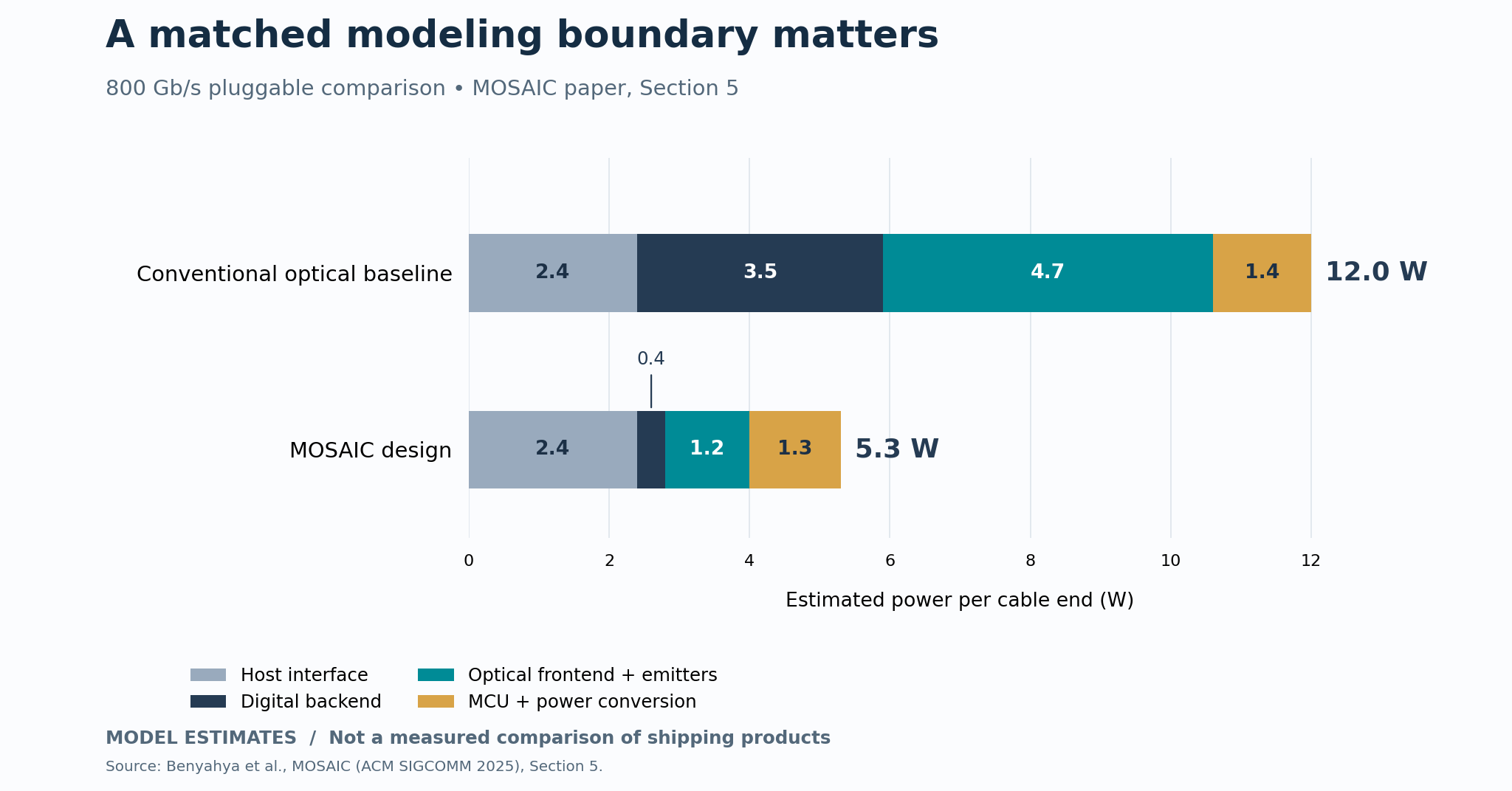
Figure 1 redraws the MOSAIC paper’s estimated power budget for an 800 Gb/s pluggable implementation: 12 W per end for its conventional optical baseline and 5.3 W for MOSAIC. The paper separates the host interface, digital backend, optical frontend, and support functions. These are modeled budgets rather than a matched test of shipping products. [4]
Microsoft’s subsequent public account anticipates commercialization with partners in late 2027 and presents energy savings as expectations informed by laboratory tests and deployment estimates. [7] That qualification belongs beside the headline. Procurement should request power at the customer’s traffic pattern, reach and thermal conditions, including both endpoints and the electronics needed to connect them.
This is also why the MOSAIC budget should not be ranked directly against Credo’s announced cable figure. Product rate, implementation and measurement boundaries differ. A useful customer comparison holds the required delivered bandwidth and operating conditions fixed, then counts the hardware and power needed to meet them. The acceptance criterion should be useful data delivery under those conditions, with any protection overhead included.
Serviceability and fault visibility are product features
Avicena frames its detachable interface as a way to support assembly, independent testing and servicing. [5] The diligence implication is concrete: measure whether repeated disconnection and reconnection preserve the accepted link behavior. Specify cleaning, inspection and replacement procedures alongside insertion-loss limits. Those proposed checks are MEMSWork recommendations, rather than claims that a supplier has failed them.
OCP’s separate Optics Reliability workstream addresses shared physical-layer telemetry, a common link-health measure and configurable responses to link flaps. [8] Its relevance here is operational: an array may tolerate individual channel problems while still needing to expose degraded health to the host. A resilience claim should therefore be connected to observable behavior, supported recovery and an unambiguous service decision.
A customer should establish which faults are tolerated, which consume spare capacity, and when replacement becomes necessary. The supplier should explain the assumptions behind lifetime estimates and the treatment of shared failures. This applies MEMSWork’s supplier-qualification framework to the cable and connector ecosystem: accountability follows the assembled function, not the component label.
The commercial opportunity includes test and integration
For strategists, the opportunity extends beyond owning an emitter technology. Alignment equipment, connector assembly, test coverage and failure analysis may become valuable positions if customers need them to qualify interchangeable links. That is a hypothesis to test through paid evaluations, repeat orders and documented production performance. Membership in a standards effort does not by itself demonstrate demand or pricing power.
The economic case should include test time, usable assembly yield, installation work, spares and service interventions. A lower component energy figure can coexist with substantial integration expense. Conversely, a connector that enables rapid isolation and replacement may create value even before peak device efficiency improves. Buyers should request a complete ownership model with its assumptions visible.
What to Watch Over the Next 12 Months
Track whether SRMO publishes usable compliance methods and whether independently supplied components can pass them together. Watch for customer evidence showing the power of complete links under disclosed conditions. Request results after representative connector handling and thermal exposure, along with channel-health records and recovery behavior.
The next commercial signal is repeatable qualification followed by customer acceptance. Announced delivery dates should be checked against actual availability and supported configurations. A standards milestone becomes more persuasive when it reduces the work required to introduce an additional supplier without rebuilding the customer’s test program.
What Would Change the Thesis?
The thesis strengthens if interchangeable links preserve their measured power advantage and remain serviceable after representative handling and aging. It weakens if alignment expense, common failures or proprietary channel mapping require extensive custom integration. An alternative architecture meeting the same customer requirements with lower total ownership cost would narrow the opportunity.
Wide parallelism deserves serious evaluation because it changes the design space. Its commercial test is whether that design freedom produces a qualified, supportable connection. The purchasing deliverable is a link whose performance, failure behavior and replacement process are understood.
Sources and methodology
Primary research, supplier announcements and OCP workstream descriptions support the evidence statements. Product targets, research measurements and modeled results are identified separately. Customer economics, production yield and fleet lifetime remain unestablished by these sources. Commercial implications and proposed acceptance tests are MEMSWork analysis. The comparison does not rank unmatched products.
[1] Credo SRMO workstream announcement, October 12, 2026.
[2] Open Compute Project SRMO workstream scope.
[3] Credo 1.6T ZeroFlap active light cable announcement, October 12, 2026.
[4] Benyahya et al., MOSAIC, ACM SIGCOMM 2025, especially Sections 5–7.
[5] Avicena connectorized LightBundle announcement, September 17, 2026.
[6] Pezeshki, GaN Micro-LEDs for Chip-to-Chip Interconnects, CS MANTECH 2025, Paper 10A.1.
[7] Microsoft account of microLED networking development, March 17, 2026.
[8] Open Compute Project Optics Reliability workstream.
Last updated November 4, 2026 (Pacific). Update history: Initial publication; subsequent material revisions will record new compliance and customer evidence.