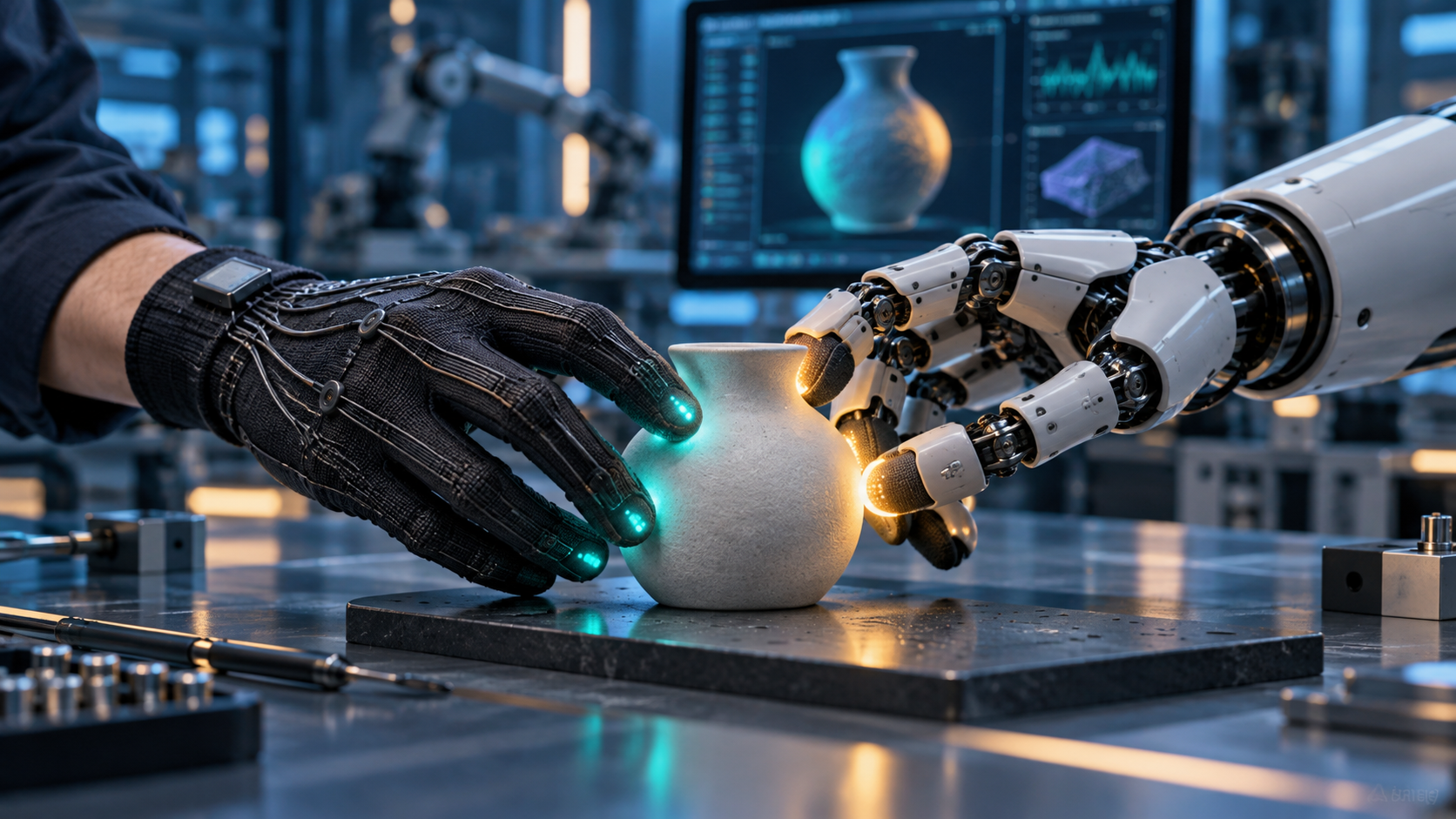
Conceptual illustration of human and robot touch. Original MEMSWork artwork; not an exact sensor design or research apparatus.
Robot Touch: The Transfer Test Behind Low-Cost Tactile Skins
Low-cost tactile skins are opening a practical route from human demonstrations to robot learning. The decisive engineering question is whether contact information remains useful when hand geometry, sensing hardware and operating conditions change. Recent studies expose competing approaches to that transfer problem. Commercial value will depend on repeatable task gains and the cost of maintaining calibrated sensing, rather than the price of the skin alone.
MEMSWork Intelligence Dashboard
| Field | Current assessment |
|---|---|
| Market status | Research prototypes and experimental learning systems; industrial deployment is not established by these studies. [1–6] |
| Primary constraint | Preserving contact meaning across sensor types, hands and replacement skins. |
| Demand driver | Contact-rich manipulation where visual observations leave important interaction states ambiguous. [1,2] |
| Time horizon | Application-specific validation; the evidence does not establish a general deployment date. |
| Technologies to watch | Shared capacitive layouts, contact-semantic adapters, optical fingertips and replaceable magnetic skins. [1,2,4,5] |
| Strategic signal | Treat tactile hardware, calibration and policy training as a jointly qualified system. |
| Next trigger | Independent transfer tests with held-out operators, sensor batches and replacement skins. |
The decision question: does cheaper touch produce useful learning?
A tactile glove can make demonstrations easier to collect without making them easier for a robot to use. The buyer’s question is therefore specific: does human touch improve the target machine’s performance after accounting for sensor integration, calibration and the robot experience still required? A convincing answer must connect an affordable sensing interface to a repeatable operational result.
This advances MEMSWork’s robot-data infrastructure analysis by examining the contact channel itself. The issue is narrower than dataset scale. A recording becomes useful only when the learning system can interpret where contact occurred, how it evolved and what the robot can do about it. Those relationships become procurement requirements when a research setup becomes a product.
What changed: hardware correspondence and software alignment
The October 1, 2026 SoTa preprint uses capacitive fabric-electrode skins with corresponding sensing locations on human and robot hands. Its shared layout contains 202 taxels, or tactile sensing elements; the reported materials cost is below $10 per skin. Human observations support task-phase learning, while executed robot demonstrations supply action supervision. With the robot demonstration budget fixed, adding human data raises mean success from 22.8% to 45.9% across eight evaluation conditions. These are experiment-specific results, not industrial acceptance rates. [1]
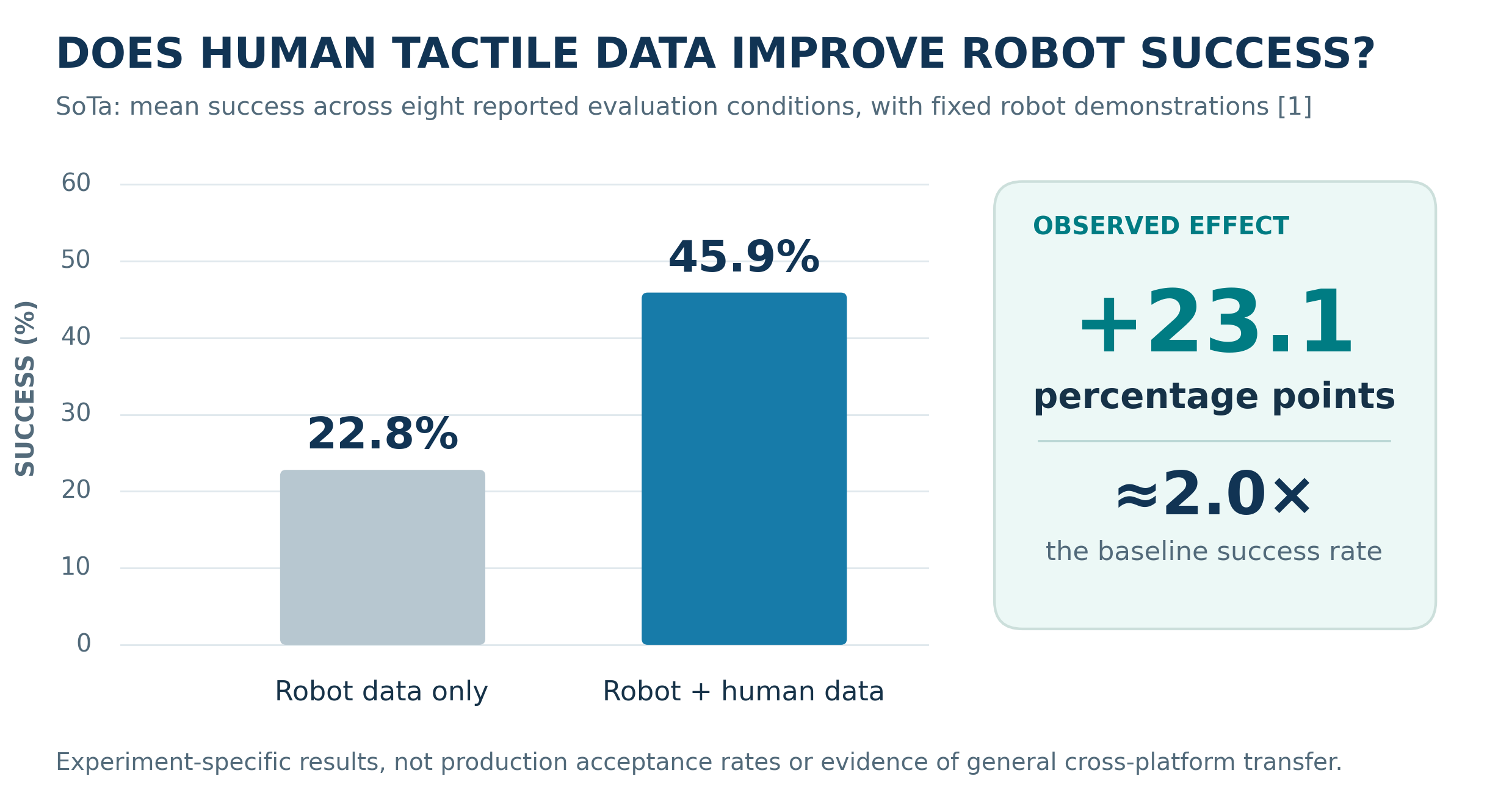
Figure 1. With the robot demonstration budget fixed, adding human tactile observations increased mean success from 22.8% to 45.9% across eight SoTa evaluation conditions [1]. This is an experiment-specific comparison, not an industrial success rate.
The October 8, 2026 TACROSS preprint takes a different route: it aligns contact events from a piezoresistive human glove and capacitive robotic sensing. Its glove bill of materials is $10.86, including the controller. The reported acquisition systems cost $520 for vision-based human capture and $12,000 for robot teleoperation; their collection rates are 140 and 40 episodes per hour, respectively. Hardware price, acquisition-system cost and collection rate are separate measures. Robot actions remain the ground-truth supervision, with human information supporting representation learning and confidence-weighted auxiliary targets. [2]
The strategic distinction is where each design pays for compatibility. Matching layouts constrains hardware choices to simplify correspondence. Heterogeneous sensing preserves hardware freedom but requires an explicit transformation between measurements. Neither approach removes the difference between observing a human action and executing that action on a robot. For diligence, the relevant comparison is the complete adaptation burden, not a contest between headline glove prices.
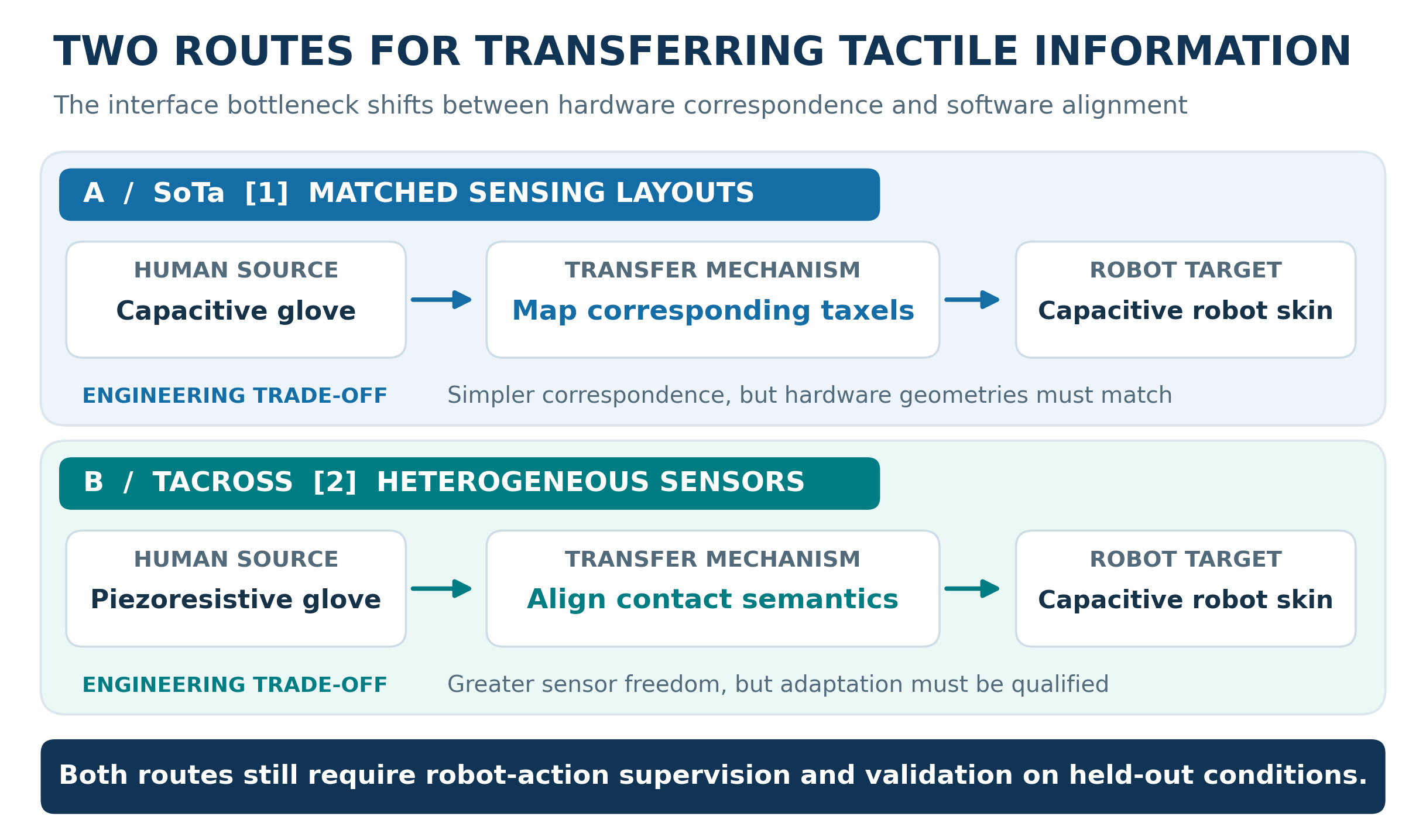
Figure 2. Alternative human-to-robot tactile transfer strategies: matched capacitive sensing layouts (SoTa) versus learned contact-semantic alignment between piezoresistive and capacitive sensors (TACROSS). Original MEMSWork synthesis based on [1,2]; not an experimental apparatus diagram.
Compare the transfer strategy, not unmatched success scores
Table 1 separates what the studies demonstrate from the questions a deployment team should ask. Their task sets and measurement boundaries differ, so their results cannot be combined into a universal performance ranking. A common evaluation should hold the robot, task, demonstration budget and acceptance criteria fixed before varying the sensing and alignment approach.
| Approach | Documented contribution | Deployment question |
|---|---|---|
| SoTa: matched layouts [1] | Corresponding capacitive contact locations support human–robot co-training. | Does correspondence survive new hand fits and replacement skins? |
| TACROSS: heterogeneous sensing [2] | Contact-semantic alignment links human glove and robot signals. | What adaptation effort is needed for another sensor or robot? |
| OpenViTac: evaluation framework [3] | Paired simulation/real settings compare tactile-policy integration. | Do benchmark gains persist in customer-held-out tasks? |
| ReSkin: replaceable interface [5] | Passive magnetic contact layer is separable from electronics. | How much recalibration follows replacement? |
Table 1. Different approaches address different parts of tactile-data transfer. Contributions are drawn from [1–3,5]; deployment questions are MEMSWork synthesis. This is not a matched performance ranking.
Sensor architecture changes the learning interface
GlowTact illustrates another interface choice: an optical fingertip mechanism directly visualizes pressure using single-color, non-directional illumination, without explicit geometry reconstruction. The reported simplification concerns the sensing mechanism; it does not demonstrate compatibility with a glove dataset or a deployed fleet. [4] A purchaser should ask which contact variables survive the representation used by the policy, and whether those variables cover the application’s failures.
ReSkin provides a complementary, older design lesson. Magnetic sensing separates the electronics from a passive contact interface that can be replaced as it wears. Its learning approach addresses response differences across fabrication and time. [5] A replaceable skin can reduce service effort, but a production contract should also define the recalibration and policy checks required after replacement.
Electrical impedance tomography offers distributed sensing with limited wiring, but bending can alter the baseline and interfere with touch interpretation. Chen and colleagues address that coupling through classification and an adaptive reference strategy in their robotic-skin study. [6] This is a reminder that a compliant interface has its own changing state. A training pipeline should distinguish deformation, valid absence of contact and an invalid measurement.
Manufacturing qualification should include the learned response
MEMSWork’s proposed qualification sequence starts with the assembled sensor. Establish mechanical fit, unloaded response and contact repeatability under the intended mounting. Preserve calibration records and identify channels whose measurements cannot be trusted. Then evaluate the same task after remounting or replacing the skin, rather than accepting continuity of an electrical trace as sufficient evidence of learning continuity.
The next step is to vary the interfaces a customer will actually encounter. Use different operators, hand fits, sensor builds and object surfaces. Track whether adaptation can be completed through a documented procedure or depends on specialist judgment. Preserve timestamps and record which measurements were available to the controller at each decision; a useful offline signal can still be unusable if it arrives too late.
These are proposed acceptance requirements, not allegations that the research teams failed their tests. Their purpose is to reveal who owns the response when something changes. The fabricator, readout supplier and policy developer should agree on the boundary between a hardware defect, a calibration problem and a model limitation before a pilot begins.
Benchmark discipline matters as much as collection speed
The October 7, 2026 OpenViTac preprint introduces paired simulation and real-world settings for evaluating visuo-tactile policies and their integration strategies. It addresses the need for a unified comparison framework, rather than proving that every tactile architecture transfers successfully. [3] Such benchmarks can help define experiments, but a customer’s acceptance test must still represent the intended objects, contact conditions and intervention limits.
A credible evaluation should reserve conditions that the training process never sees. Report the distribution of outcomes, including failed grasps and operator interventions, alongside aggregate success. Compare against a vision-only policy and a robot-only tactile policy with equivalent collection effort. Otherwise an apparent sensor advantage may reflect extra data, different training or easier evaluation conditions.
The business case belongs at the usable-episode boundary
The proposed economic metric is total acquisition and adaptation cost divided by usable learning episodes. Include fabrication labor, electronics, fitting, calibration, recording equipment, invalid episodes, annotation and retraining. A cheap glove may be valuable even when it requires substantial supporting infrastructure, provided the resulting episodes reduce a more expensive bottleneck. A low materials cost alone cannot establish that outcome.
For suppliers, defensible value may reside in reproducible fabrication, replaceable interfaces, calibration tools or validated adapters tied to a named application. Corporate partnerships should connect those capabilities to the robot integrator’s task requirements. MEMSWork’s soft-robot sensor development framework supplies the broader engineering context; the current opportunity is to measure transfer as a deliverable.
Investment milestones should follow accepted capability: evidence that the system reduces collection or integration effort while preserving the customer’s required outcome. That complements the commercial-proof test for humanoid robotics. A sensor business benefits when its contribution can be traced to reliable work, renewal demand and manageable service effort.
What to Watch Over the Next 12 Months
Watch for independent reproduction of human-to-robot tactile transfer and public releases of fabrication files, readout software and synchronized datasets. Check whether promised resources are actually available, documented and licensed for the intended use. Follow comparisons that keep robot demonstrations fixed and separate the contribution of contact information from extra training volume.
The most revealing manufacturing signal will be performance after sensor replacement and across fabrication batches. Track calibration time, invalid-channel handling and dependence on manual fitting. For commercial pilots, seek customer-defined tasks, sustained operation and an accounting of interventions and maintenance, rather than treating collection throughput as deployment productivity.
What Would Change the Thesis?
The thesis strengthens if human tactile data improves held-out robot tasks with less total collection and adaptation effort, and that benefit survives new operators and replacement skins. It weakens if calibration, retargeting and retraining consume the savings, or if gains disappear when evaluation conditions change. A vision-only or simpler force-sensing system meeting the same requirement at lower total cost would also narrow the opportunity.
The immediate decision is to qualify a transfer pathway for a defined application. Recent research provides concrete alternatives to test. Commercial conviction should rise when cheaper capture produces repeatable usable learning, with clear ownership of the hardware, calibration and model interfaces.
Sources and methodology
Research results are attributed to their original teams. Recent preprints are experimental evidence, not independent industrial qualification. Numerical claims were checked against the cited manuscripts or abstracts. The comparison and proposed acceptance criteria are MEMSWork analysis; no market-size or production-yield estimate is inferred.
[1] Yang et al., SoTa: Soft Tactile Skins for Dexterous Manipulation, preprint, October 1, 2026
[5] Bhirangi et al., ReSkin: versatile, replaceable, lasting tactile skins, CoRL/PMLR paper
Last updated October 14, 2026 Pacific. Update history: Initial assessment published. Future revisions should record independent transfer results, sensor-replacement performance and customer qualification evidence.